

Yes, most double chins can be meaningfully improved without surgery. If your concern is mild-to-moderate submental fat, a well-planned non-surgical approach can deliver a noticeably cleaner jawline over weeks to months. Johns Hopkins Medicine notes that non-surgical options are generally effective for mild-to-moderate submental fullness, but significant skin laxity usually calls for surgery. A practical first step is the pinch test (described below), followed by a consultation with a licensed clinic to confirm which driver is causing your double chin before committing to treatment.
Quick self-check before you book:
- Pinch the skin under your chin. If you can gather a noticeable layer of soft tissue, excess fat is likely the main driver.
- If the skin feels thin but droops, laxity may be the bigger issue.
- If your chin appears recessed even when you're at a healthy weight, bone structure or genetics may be contributing.
Key Takeaways
Non-surgical double chin reduction works best when the treatment matches the cause: fat-reduction modalities for submental fat, RF or HIFU for skin laxity, and lymphatic care to support and extend both.
| Point | Details |
|---|---|
| Diagnosis drives results | Identify whether fat, laxity, or bone structure is the main cause before choosing any treatment. |
| Realistic timeline | Visible improvement takes weeks to months; RF and HIFU collagen remodeling continues for up to three to six months. |
| Sessions and spacing | Most modalities require 1–6 sessions spaced roughly four weeks apart for the body to process results. |
| Combination therapy wins | Pairing fat reduction with RF jawline tightening and lymphatic drainage produces more natural outcomes than any single modality. |
| Houseofwellnesssg | Offers personalized multi-modal plans in Singapore combining radiofrequency, cryotherapy, microcurrent, and lymphatic care. |
Table of Contents
- What are the main non-surgical double chin options?
- How do you know what's causing your double chin?
- Which non-surgical treatments work for each cause?
- What results and timeline should you realistically expect?
- What are the risks and side effects to know about?
- How do you choose the right clinic in Singapore?
- What most people underestimate about non-surgical results
- Houseofwellnesssg: a tailored non-surgical plan in Singapore
- Sources
What are the main non-surgical double chin options?
| Treatment | How it works | Typical sessions | Downtime | Best for |
|---|---|---|---|---|
| Injectable fat-dissolvers | Destroys fat cell membranes via deoxycholic acid | Multiple treatment sessions spaced at least a few weeks apart | 1–2 weeks swelling | Submental fat |
| Cryolipolysis / cryotherapy | Freezes and eliminates fat cells | Multiple sessions may be needed | Minimal | Submental fat |
| Radiofrequency (RF) | Heats dermis to stimulate collagen | Several sessions usually required | Minimal | Mild laxity + fat |
| HIFU / ultrasound | Ultrasound energy tightens deeper tissue | Few sessions typically recommended | Minimal | Skin laxity |
| Mesotherapy | Micro-injections of fat-dissolving compounds | Multiple sessions spaced weeks apart | Mild redness | Mild fat |
| Lymphatic drainage / microcurrent | Manual or electrical stimulation for drainage and tone | Ongoing or as add-on | None | Supportive care |
As CareCredit's treatment guide explains, cryolipolysis, mesotherapy, radiofrequency, and laser lipolysis each have distinct session profiles and progressive result timelines. A single modality rarely delivers the full picture. Combining fat reduction with RF jawline tightening and lymphatic care produces more natural-looking results than any one approach alone.
How do you know what's causing your double chin?
Healthline's overview identifies four main drivers: excess submental fat, skin laxity, genetics, and jaw or bone structure. Knowing which one dominates your situation shapes every treatment decision.
Signs that fat is the primary cause:
- The fullness increases when you gain weight and decreases when you lose it.
- The pinch test yields a soft, pliable layer of tissue.
- The area feels firm but not taut.
Signs that skin laxity is the main issue:
- The skin under the chin feels thin and loose even at a stable weight.
- Pulling the skin upward shows a noticeably sharper jawline.
- The concern worsened after significant weight loss or with age.
When genetics or bone structure plays a role: A recessed chin or short jaw can create the visual impression of a double chin even when fat and skin are both normal. Non-surgical fat reduction won't resolve this; a clinician may suggest RF jawline tightening or HIFU to improve definition, or refer you for a structural assessment.
See a clinician in person if the fullness appeared suddenly, feels firm or nodular, or is accompanied by discomfort. Those are red flags that warrant a medical assessment before any cosmetic treatment.
Which non-surgical treatments work for each cause?
Injectable fat-dissolvers (deoxycholic acid)
Deoxycholic acid disrupts fat cell membranes, causing the cells to break down and be cleared by the body over several weeks. KYBELLA's prescribing information specifies up to 50 injections per session and up to six sessions spaced at least one month apart. Swelling after each session can be visible for one to two weeks, so plan your social calendar accordingly.
Cryolipolysis and cryotherapy
Controlled cooling targets and destroys fat cells without affecting surrounding tissue. Results appear progressively as the body clears the treated cells, typically over several weeks to a few months. Downtime is minimal, making this a practical option for busy schedules. Houseofwellnesssg's cryotherapy service applies this principle in a targeted, comfortable setting.
Radiofrequency and HIFU
Radiofrequency delivers controlled heat into the dermis, stimulating collagen production and gradually tightening the skin. RF jawline tightening and radiofrequency jawline tightening protocols typically require three to six sessions for meaningful collagen remodeling. HIFU (High-Intensity Focused Ultrasound) reaches deeper tissue planes and can produce firmer lifting with fewer sessions. Both are well-suited to mild laxity and work best when paired with a fat-reduction modality.
Mesotherapy
Micro-injections of phosphatidylcholine or similar compounds target localized fat deposits. Sessions are spaced two to four weeks apart, with mild redness or swelling for a day or two. Results are gradual and suit those with mild submental fullness who prefer a gentler approach.
Lymphatic drainage, microcurrent, and supportive therapies
These modalities don't reduce fat directly, but they play a meaningful supporting role. Lymphatic drainage massage reduces post-treatment swelling and helps the body clear metabolized fat cells more efficiently. Microcurrent sculpting tones the underlying muscles and improves definition along the jawline. Used in sequence after a contouring treatment, they extend and refine results.

Pro Tip: Sequence your treatments: start with a fat-reduction modality (cryo or injectables), then layer in RF or HIFU for skin tightening, and finish with lymphatic drainage to clear debris and reduce swelling. This staged approach, spaced about four weeks apart, gives each modality time to work before the next builds on it.
As Livist Medical's guide notes, combining contouring with skin tightening and lymphatic care consistently produces more satisfying, natural-looking outcomes than a single-modality plan.
What results and timeline should you realistically expect?
There is no overnight fix. The Cleveland Clinic is direct on this: non-surgical procedures require weeks to months for visible improvement, and diet and exercise alone are the primary non-procedural routes. Chin exercises can strengthen jaw and neck muscles, but they do not reliably spot-reduce submental fat.
For injectable fat-dissolvers, early changes appear around four to six weeks after the first session, with full results visible after the complete course. Cryolipolysis results typically emerge over six to twelve weeks as the body clears treated fat cells. RF and HIFU collagen remodeling continues for up to three to six months after the final session, which is why patience matters.
Longevity depends on your weight stability and age. Fat-reduction results can be long-lasting if your weight stays stable. Skin-tightening results from RF and HIFU typically hold for one to two years before a maintenance session is worthwhile. Scheduling treatments at least eight to twelve weeks before a significant event gives you a realistic buffer for results to appear.
What are the risks and side effects to know about?
Most non-surgical chin treatments are well-tolerated, but every modality carries a specific risk profile. Injectable fat-dissolvers commonly cause swelling, bruising, and numbness at the injection site; the KYBELLA prescribing information lists edema and pain among adverse reactions occurring in more than 20% of patients. Swelling can persist for one to two weeks. A less common but serious risk with submental injections is marginal mandibular nerve injury, which can temporarily affect the smile. Technique and anatomical knowledge matter enormously here. Cryolipolysis and RF/HIFU carry minimal downtime but may cause transient numbness, redness, or tingling. Defer any treatment if you are pregnant, taking anticoagulants, or have active infection or scarring in the treatment area. Always disclose prior surgeries in the submental region.
How do you choose the right clinic in Singapore?
Credentials to verify
- Medical oversight: confirm a licensed doctor is involved in assessment and injectable treatments.
- Practitioner training: ask specifically about training in energy devices (RF, HIFU) and injectable fat-dissolvers.
- Facility standards: the clinic should follow Singapore's Ministry of Health aesthetic treatment guidelines.
Questions to ask at your consultation
- What is the likely primary cause of my double chin, and which treatment do you recommend for that cause?
- How many sessions do you expect I'll need, and how will you space them?
- What side effects should I expect, and what is the recovery plan?
- Can I see before-and-after photos from clients with a similar profile?
- What does informed consent cover, and what aftercare support do you provide?
- How is pricing structured — per session or as a package?
Red flags to walk away from:
- No in-person or thorough online assessment before recommending a treatment plan.
- Guarantees of dramatic results in a single session.
- No informed consent process or written aftercare instructions.
- Pressure to purchase a large package before you've had a diagnostic conversation.
What most people underestimate about non-surgical results
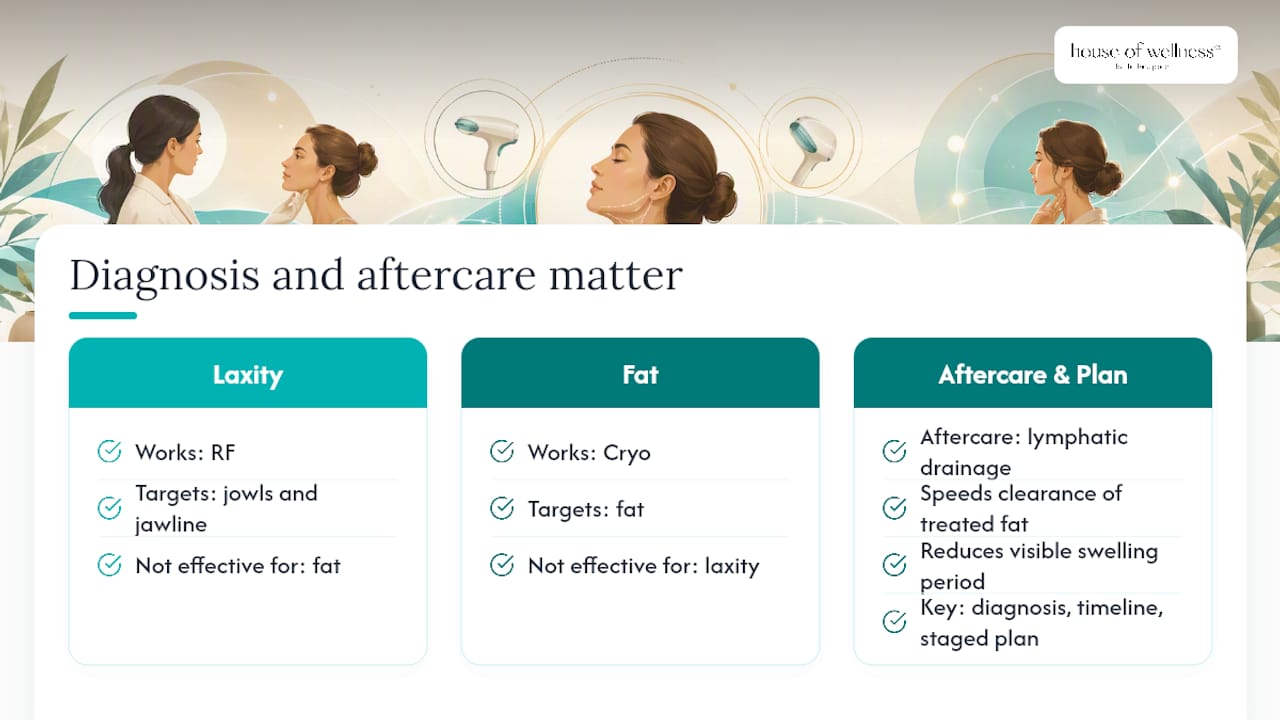
The gap between what people expect and what non-surgical treatments can deliver is almost always a diagnosis problem, not a technology problem. Readers often arrive at a clinic hoping for a single-session fix, having seen a before-and-after photo that represents a six-session, multi-modal journey. The treatments themselves are genuinely effective when matched to the right cause. RF for jowls and RF jawline tightening work beautifully for laxity. Cryo works for fat. Neither works well for the other's problem.
What also gets underestimated is the role of aftercare. Lymphatic drainage in the days following an injectable or cryo session doesn't just soothe; it actively speeds the clearance of treated fat cells and reduces the visible swelling period. Clients who treat aftercare as optional often feel their results are slower or less defined than they should be.
The most satisfied clients are those who arrive with a clear diagnosis, a realistic timeline, and a staged plan they actually follow. That combination, more than any single device or injection, is what produces a result worth showing off.
Houseofwellnesssg: a tailored non-surgical plan in Singapore
Houseofwellnesssg offers something most single-modality clinics don't: a genuinely personalized, multi-modal approach that pairs fat contouring with skin tightening and lymphatic care in one cohesive plan. At the Tanjong Pagar clinic, your session can combine radiofrequency heat for collagen stimulation, cryotherapy for targeted fat reduction, and microcurrent sculpting for jawline definition, all sequenced to your anatomy and your schedule. There's no pressure to commit to a large package before you've had a proper assessment.

A practical starting point is the 90-minute Ideal Balance session, which can be adapted into a focused chin and jawline protocol. Browse the full services menu to see how treatments combine, then book your consultation to get a diagnosis-first plan built around your specific concern.
Sources
The following sources informed this guide. Clinical references are marked accordingly.
- Double Chin Surgery: What You Need to Know | Johns Hopkins Medicine
- KYBELLA prescribing information highlights (deoxycholic acid)
- How To Get Rid Of A Double Chin | Cleveland Clinic
- Ditch the Double Chin: 5 Non-Surgical Options Explained | CareCredit
- How to get rid of a double chin | Healthline
This article is general information, not a substitute for advice from a qualified doctor. Consult a qualified healthcare professional about your own circumstances before acting on anything here.