

Most post-flight swelling is harmless. The medical term is dependent edema, and it happens when fluid pools in your lower legs and feet after sitting still for hours. Mayo Clinic confirms that this kind of swelling is common, typically painless, and resolves on its own with movement and elevation after landing. What you need to watch for is swelling that is one-sided, painful, warm, or red — those are signs that need urgent medical attention, not a home remedy.
Do this first when you land:
- Stand up and walk, even just to the gate exit
- Remove tight shoes or loosen laces immediately
- Elevate your legs above heart level when you sit or rest
- Drink water and avoid salty airport snacks
- Check both legs: is the puffiness equal on both sides?
Pro Tip: Symmetry is your fastest triage tool. Harmless travel edema puffs up both legs roughly equally and feels soft and painless. A blood clot (DVT) almost always affects one leg, with calf or thigh tenderness and a feeling of warmth. If one leg looks noticeably more swollen than the other, skip the home remedies and head to a clinic.
Table of Contents
- Why your legs and feet swell after flying
- How to prevent swelling before and during the flight
- Evidence-based steps to reduce swelling after you land
- Red flags and when to seek medical attention in Singapore
- How long swelling usually lasts after a flight
- What the evidence says about compression, movement, and lymphatic care
- Key Takeaways
- A wellness practitioner's perspective on post-flight recovery
- Restore and recover at Houseofwellnesssg in Singapore
- Authoritative sources and further reading
Why your legs and feet swell after flying
The primary driver is something called the calf-muscle pump. When you walk, your calf muscles contract and squeeze blood and lymph fluid upward through your veins and lymphatic vessels toward the heart. Sit still for three or more hours, and that pump goes nearly silent. Blood and fluid gradually pool in the lower legs and feet under the pull of gravity — that pooling is dependent edema.
Several factors layer on top of this basic mechanism:
- Reduced muscle contractions: Cramped seating limits natural leg movement, slowing venous return.
- Cabin pressure: Aircraft cabins are pressurized to the equivalent of roughly 6,000–8,000 feet altitude, which causes mild vasodilation and can increase fluid leakage from capillaries into surrounding tissue.
- Low cabin humidity: Cabin air is very dry, typically below 20% relative humidity. Your body loses moisture through breathing and skin, which can contribute to relative dehydration and affect fluid balance.
- High-sodium pre-flight meals: Salt encourages the body to retain water, amplifying any existing fluid shift.
- Underlying conditions: Pre-existing venous insufficiency, lymphedema, or varicose veins make swelling more pronounced and slower to resolve.
Here is how the calf-muscle pump works in plain terms: when you take a step, your calf contracts and compresses the deep veins, pushing blood upward. One-way valves in those veins prevent backflow. When you stop moving, the valves hold, but the pump stops generating pressure. Over a long flight, the valves alone cannot fully compensate, and fluid gradually accumulates below the knee.
| Flight duration | Edema risk | DVT risk | Recommended precaution |
|---|---|---|---|
| Under 4 hours | Low to moderate | Very low | Hydration, occasional movement |
| 4–8 hours | Moderate | Low but present | Compression stockings, regular in-seat exercises |
| Over 8 hours | High | Rises with duration | Compression stockings, frequent movement, consider medical advice if risk factors present |
| Over 12 hours | High | More significant | All of the above; discuss prophylaxis with a clinician if you have risk factors |
How to prevent swelling before and during the flight
Prevention genuinely begins before you board. The steps below are ordered by impact, not by effort.
Before you fly:
- Drink water consistently in the 24 hours before your flight, not just at the gate
- Choose a lower-sodium meal the evening before and the morning of travel
- Wear loose, comfortable clothing that does not constrict the thigh or calf
- Pack graduated compression stockings and put them on before boarding, not after swelling starts
- Choose footwear with adjustable lacing or a wider fit to accommodate mild swelling
In-seat exercises (every 20–30 minutes):
- Ankle pumps: Flex your foot up toward your shin, then point it down. Repeat 10–15 times per foot.
- Calf raises: Press the balls of your feet into the floor and lift your heels. Hold briefly, lower slowly. Ten repetitions.
- Foot circles: Rotate each foot clockwise and counterclockwise, 10 circles each direction.
- Seated marching: Lift alternate knees toward your chest in a slow, controlled march for 30 seconds.
These movements re-engage the calf-muscle pump and keep lymph and venous return moving. Mayo Clinic recommends regular movement and calf activation as the most practical in-flight prevention strategy.
Choosing compression stockings:
| Feature | What to look for |
|---|---|
| Length | Knee-high is sufficient for most travelers; thigh-high for those with varicose veins or prior DVT |
| Compression class | Mild (15–20 mmHg) for healthy travelers; moderate (20–30 mmHg) for those with venous conditions |
| Sizing | Measure calf circumference and ankle circumference; never guess by shoe size |
| Timing | Put them on before boarding, before any swelling begins |
Pro Tip: Compression stockings work by applying graduated pressure, tightest at the ankle and gradually lighter toward the knee. That gradient actively assists venous return. If you wait until your feet are already puffy to put them on, the stocking is harder to fit and less effective. Lay them out the night before your flight so you do not forget.
A systematic review published in PMC found that graduated compression stockings have strong clinical evidence for reducing lower-limb edema and asymptomatic clots on long-duration flights. For flights over 8 hours, they are the single most evidence-backed non-pharmacologic tool you have.
Evidence-based steps to reduce swelling after you land
Landing with puffy ankles is uncomfortable, but the recovery routine is straightforward. Follow these steps in order.
- Remove tight footwear — Loosening your shoes or switching to sandals lets circulation normalize and prevents the swelling from being compressed into a smaller space. Mayo Clinic notes that tight shoes worsen inflight puffiness and make re-donning footwear uncomfortable before landing.
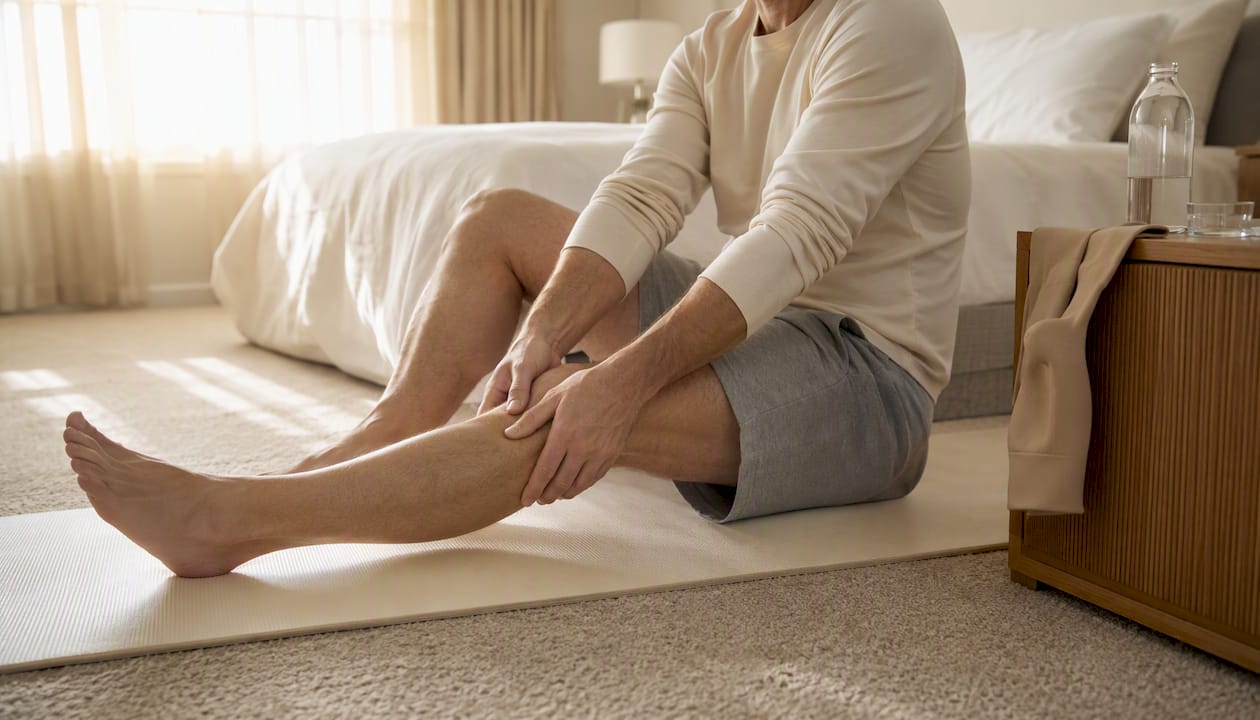
Safety note: Do not vigorously massage a leg that is painful, warm, red, or more swollen than the other. If there is a clot present, aggressive massage could dislodge it. Gentle movement is safe; deep pressure on a symptomatic leg is not.
When swelling is persistent or uncomfortable after the steps above, professional manual lymphatic drainage (MLD) can help clear residual fluid. MLD is a gentle, specialized technique performed by trained practitioners that encourages lymphatic flow without the pressure risks of deep tissue massage. It works best as a complement to movement and compression, not a replacement.
Red flags and when to seek medical attention in Singapore
The NHS advises seeking prompt medical evaluation for the following signs. Save this checklist to your phone before you travel.
Go to A&E immediately if you have:
- Swelling in one leg only, especially with calf or thigh pain
- Warmth or redness over the swollen area
- Shortness of breath or chest pain (these can indicate a pulmonary embolism)
- A leg that feels hard or tight to the touch
See a GP or urgent care clinic if:
- Swelling is symmetric but has not improved after 48–72 hours
- You have known risk factors (recent surgery, active cancer, prior blood clot, pregnancy, or hormonal contraceptives)
- You feel generally unwell alongside the swelling
In Singapore: Polyclinics and 24-hour GP clinics are accessible across the island for non-emergency review. For urgent symptoms — one-sided swelling with pain, chest tightness, or breathlessness — go directly to the A&E department at Singapore General Hospital, Tan Tock Seng Hospital, or the nearest restructured hospital.
When you see a clinician, tell them: the total flight duration, how long ago you landed, which leg is affected, and whether you have any of the risk factors above. That information helps them triage quickly.
A systematic review on air travel-associated venous thromboembolism confirms that DVT risk is very low for healthy travelers on flights under about 4 hours. Risk rises meaningfully on flights exceeding 12 hours, particularly for those with pre-existing clot risk factors.
How long swelling usually lasts after a flight
For most travelers, the timeline is reassuring. Mayo Clinic confirms that flight-related foot and leg swelling is common and generally resolves within hours of landing with normal movement.
A practical breakdown:
- Within 1–3 hours of landing: Significant improvement with walking and elevation for most short- to medium-haul flights
- Within 24 hours: Most travel-related swelling from flights of 4–8 hours clears with consistent movement and rest
- 48–72 hours: Expected resolution window for long-haul flights (8 hours or more), particularly if you were sedentary during the flight
The NHS notes that swelling persisting beyond 24–72 hours, especially in travelers with ongoing risk factors such as recent surgery or prior venous thromboembolism, warrants clinical review. Worsening swelling at any point is a reason to seek evaluation sooner.
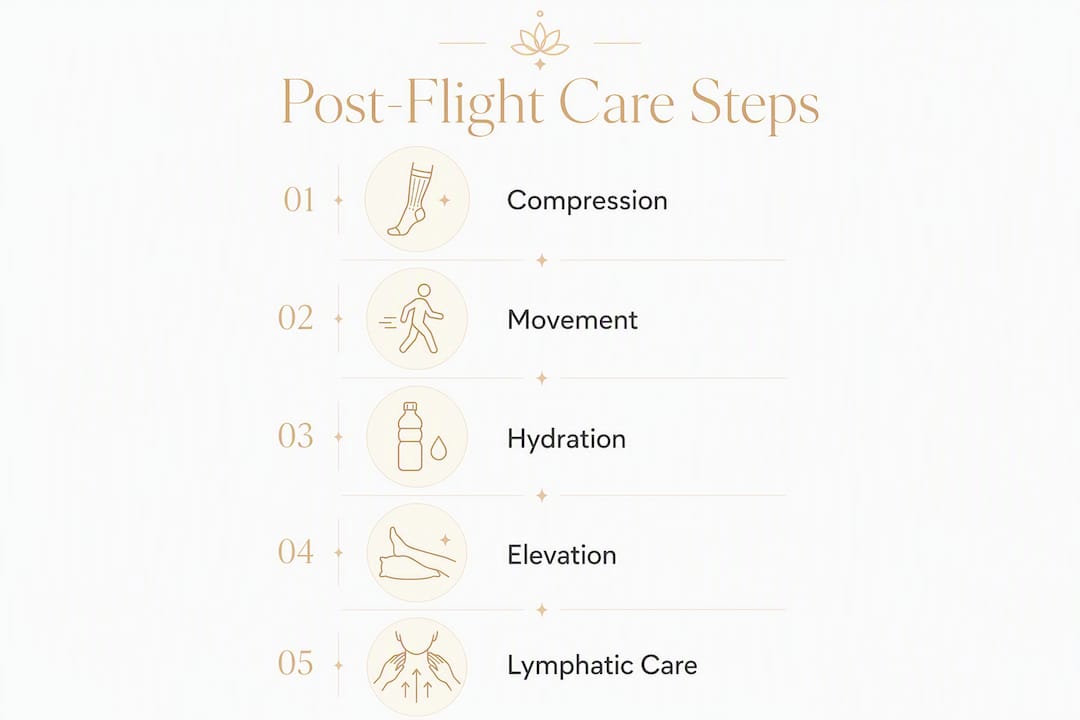
Three things speed recovery during this window: consistent gentle movement (short walks every hour or two), leg elevation during rest, and wearing compression stockings through the first day post-flight. Sleeping with your feet slightly elevated on a pillow the first night after a long-haul flight also helps.
What the evidence says about compression, movement, and lymphatic care
The research picture on flight-related swelling is clearer than many travelers realize.
Compression stockings: The PMC systematic review on air travel-associated venous thromboembolism found that graduated compression stockings reduce lower-limb edema and asymptomatic clots on long-duration flights. This is the strongest non-pharmacologic evidence available for flight-related swelling prevention.
Movement: Mayo Clinic guidance consistently identifies regular calf activation as the most practical in-flight prevention step, supporting the physiological case for the calf-muscle pump.
Hydration and sodium: Pre-flight hydration and low-sodium meals reduce the fluid retention that amplifies edema. These are low-effort, high-impact steps.
Manual lymphatic drainage: Clinical practice recognizes MLD as a useful complement for residual fluid clearance after travel, particularly for travelers with lymphatic or venous conditions. It should be delivered by trained practitioners and used alongside movement and compression, not as a standalone fix.
Who needs pharmacologic prophylaxis? Aspirin and anticoagulants are sometimes discussed for high-risk travelers. The evidence for aspirin alone is weak. Anticoagulants carry bleeding risks. If you have a history of DVT, active cancer, or recent major surgery, speak with your clinician before a long-haul flight — not after.
Pro Tip: Compression plus movement is the best-supported non-pharmacologic strategy for long flights. Neither alone is as effective as both together. Think of the stocking as the passive assist and the ankle pump as the active engine.
The NHS red-flag guidance reinforces that one-sided swelling, pain, warmth, and redness require prompt evaluation regardless of how recently you flew. Symmetric, painless puffiness is almost always benign dependent edema.
Key Takeaways
Symmetric, painless swelling in both legs after a flight is almost always harmless dependent edema that resolves within hours to 72 hours with walking, elevation, and compression.
| Point | Details |
|---|---|
| Compression stockings work | Graduated stockings reduce edema and asymptomatic clots on long flights; put them on before boarding. |
| Movement is the active engine | Ankle pumps and calf raises every 20–30 minutes keep the venous pump working during flight. |
| Symmetry is your triage cue | Symmetric, painless puffiness is benign; one-sided pain and warmth need urgent medical review. |
| Swelling clears within hours to 72 hours | Most long-haul flight swelling resolves within hours to 72 hours with consistent walking, elevation, and compression. |
| Houseofwellnesssg for persistent recovery | For non-urgent, lingering swelling, Houseofwellnesssg offers lymphatic drainage massage and restorative body therapies in Singapore. |
A wellness practitioner's perspective on post-flight recovery
The travelers who recover fastest from flight-related swelling are not the ones who do the most — they are the ones who do the right things in the right order. Walk first. Elevate second. Compress third. That sequence mirrors how the body's own fluid-return system works, and it is more effective than any single intervention alone.
What gets overlooked is the lymphatic side of the equation. Venous return gets most of the attention, but the lymphatic system carries a meaningful share of interstitial fluid, and it has no pump of its own. It depends entirely on muscle movement, breathing, and gentle external pressure. After a long-haul flight, that system is sluggish. A session of manual lymphatic drainage does not just feel soothing — it physically encourages fluid movement through channels that passive rest alone cannot fully clear.
The other thing worth saying plainly: most people who land with puffy ankles do not have a blood clot. But the ones who do often dismiss the symptom as "just travel swelling" for too long. The symmetry check takes five seconds. Do it every time.
Restore and recover at Houseofwellnesssg in Singapore
When walking and elevation are not enough and your legs still feel heavy a day or two after landing, a professional recovery session can make a real difference. Houseofwellnesssg at Tanjong Pagar offers lymphatic drainage massage specifically designed to support fluid clearance and ease post-travel fatigue, alongside gentle body therapies including cryotherapy and radiofrequency body treatments that relax tissue and restore circulation.
These are wellness sessions, not medical treatments. They are most appropriate for symmetric, non-painful swelling that has already been cleared of red flags. If you have one-sided swelling, pain, warmth, or redness, please seek medical evaluation before booking any body therapy.
For travelers who want a complete restorative experience after a long-haul flight, the ProRestore treatment combines targeted body work with relaxation techniques in a calm, unhurried environment. You can view all available sessions and book directly at houseofwellnesssg.com/services.
Authoritative sources and further reading
The following sources were used to inform this article. Always verify publication dates and consult a qualified clinician for personalized advice.
- Foot swelling during air travel: A concern? — Mayo Clinic — Covers the common causes of flight-related foot and leg swelling, practical prevention steps, and when to seek care.
- Systematic review on air travel-associated venous thromboembolism — PMC — Peer-reviewed evidence on DVT risk thresholds by flight duration and the effectiveness of graduated compression stockings.
This article provides general wellness information only. It is not a substitute for professional medical advice. If you are concerned about your symptoms, consult a qualified clinician or visit your nearest A&E.