
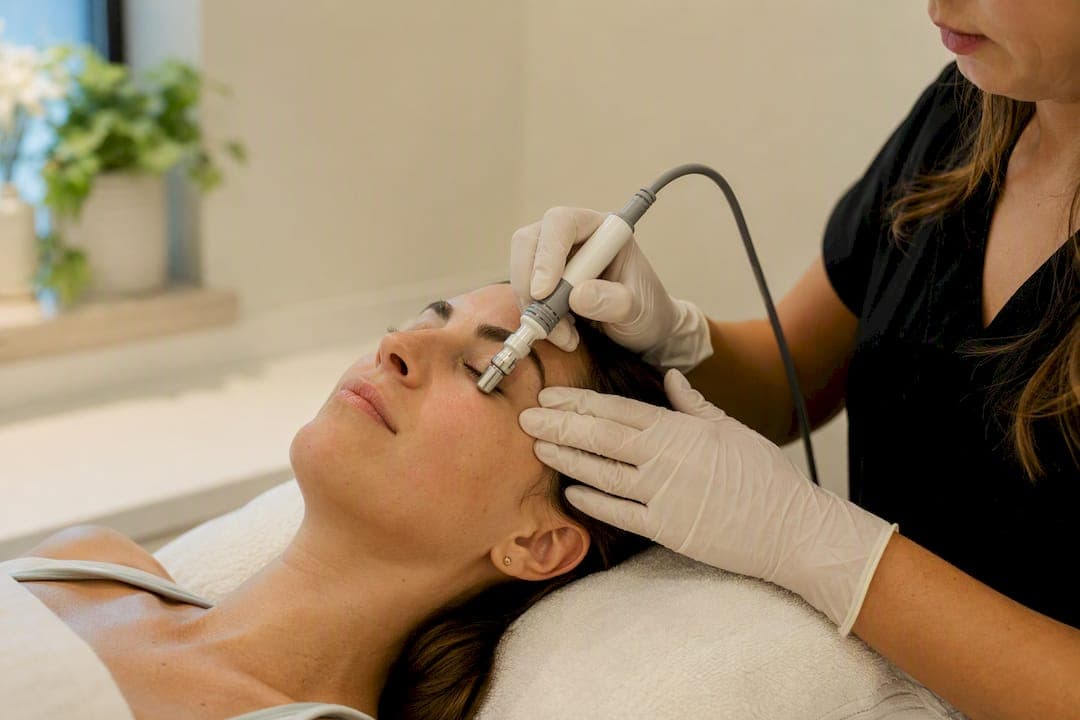
Radiofrequency eye treatment uses controlled heat to tighten periocular skin and soften fine lines by stimulating collagen remodeling, and it does this without surgery or downtime. Evidence backs this up with real numbers: one clinical study that found a 33.26% improvement by photodocumentation after five weekly nonablative RF sessions, and a separate trial on Plasma IQ recorded a 22.51% gain in skin elasticity at 90 days. Safety hinges on the clinic: temperature-controlled devices and opaque scleral shields protect the eye itself, and operator training determines whether you get results or complications.
- RF triggers collagen contraction now and new collagen production over the following months.
- Studies show measurable elasticity and tightening gains, not just subjective "looks better" claims.
- Protective eye shields and temperature feedback are non-negotiable safety features to ask about.
Pro Tip: Before booking, ask the clinic which device they use and whether they can show you objective before-and-after measurements, not just photos.
Key Takeaways
Radiofrequency eye treatment works by heating the dermis to trigger collagen contraction and remodeling, producing measurable tightening over a series of sessions when delivered with proper eye protection and temperature control.
| Point | Details |
|---|---|
| Results build over time | Immediate mild tightening appears first, with true remodeling visible at 6 to 12 weeks. |
| Sessions matter | Typical protocols run three to six sessions spaced several weeks apart, depending on the device. |
| Safety depends on equipment | Opaque scleral shields and temperature feedback protect the eye during upper-lid treatment. |
| Not everyone is a candidate | Significant fat prolapse or excess skin usually needs surgical blepharoplasty instead. |
| House of Wellness approach | Combines evidence-based RF protocols with medical oversight and a customized, relaxation-focused spa experience. |
Table of Contents
- How Does Radiofrequency Eye Treatment Actually Work?
- What Types of RF Are Used Around the Eyes?
- How Many Sessions Does RF Eye Treatment Take?
- Is RF Safe for the Delicate Skin Around Your Eyes?
- Who Is a Good Candidate for RF Eye Treatment?
- How Do You Choose a Clinic for RF Eye Treatment?
- What Aftercare Does RF Eye Treatment Require?
- Why House of Wellness Takes an Evidence-First Approach
- Book Your Radiofrequency Eye Treatment Consultation
- Selected Research on RF Eye Treatments
- Frequently Asked Questions
- Sources
How Does Radiofrequency Eye Treatment Actually Work?
RF delivers electromagnetic energy that converts to heat once it hits the dermis, and that heat does two things at once. It causes existing collagen fibers to contract immediately, which is why some patients notice mild tightening immediately after a session. The more meaningful change happens over the following weeks: fibroblasts activate, elastin production increases, and the dermis slowly rebuilds itself with denser collagen. That process, called neocollagenesis, is what produces a lasting lift rather than a temporary illusion.
This isn't guesswork dressed up as science. Clinicians track it with cutometry (a device that measures skin elasticity), photodocumentation, and eyelid margin distance to see how much skin has lifted relative to the lash line. A 2025 review of RF facial rejuvenation confirms this mechanism across device types, noting that histologic samples show genuine collagen remodeling, not just swelling that fades in a week.
That's the kind of objective tracking worth asking your clinic about directly.
What Types of RF Are Used Around the Eyes?
Different RF types reach different depths, and depth is what determines whether a device treats fine lines, mild sagging, or a heavier brow. Choosing the right one is less about brand names and more about matching the tool to your specific concern.
- Monopolar RF penetrates deepest and works well for brow elevation and upper-lid firmness. A study on Asian patients using a shallow 0.25 cm² tip reported that a majority saw marked improvement at two months, rising further by six months, with no adverse events recorded.
- Bipolar RF stays closer to the surface, making it a common choice for thinner periocular skin where a lighter touch matters.
- Fractional RF microneedling creates controlled micro-channels to remodel deeper dermal layers, useful for texture and crepiness beyond the lash line.
- Microcurrent or plasma RF variants, like Plasma IQ, combine gentle current with RF for precise work directly around the eye, where tissue is thinnest and most reactive.
Energy level, frequency, and exposure time all vary by device and clinic protocol, and this is where specialized safety measures, like temperature-controlled treatment paired with opaque scleral shields for upper-eyelid work, become essential rather than optional.
How Many Sessions Does RF Eye Treatment Take?
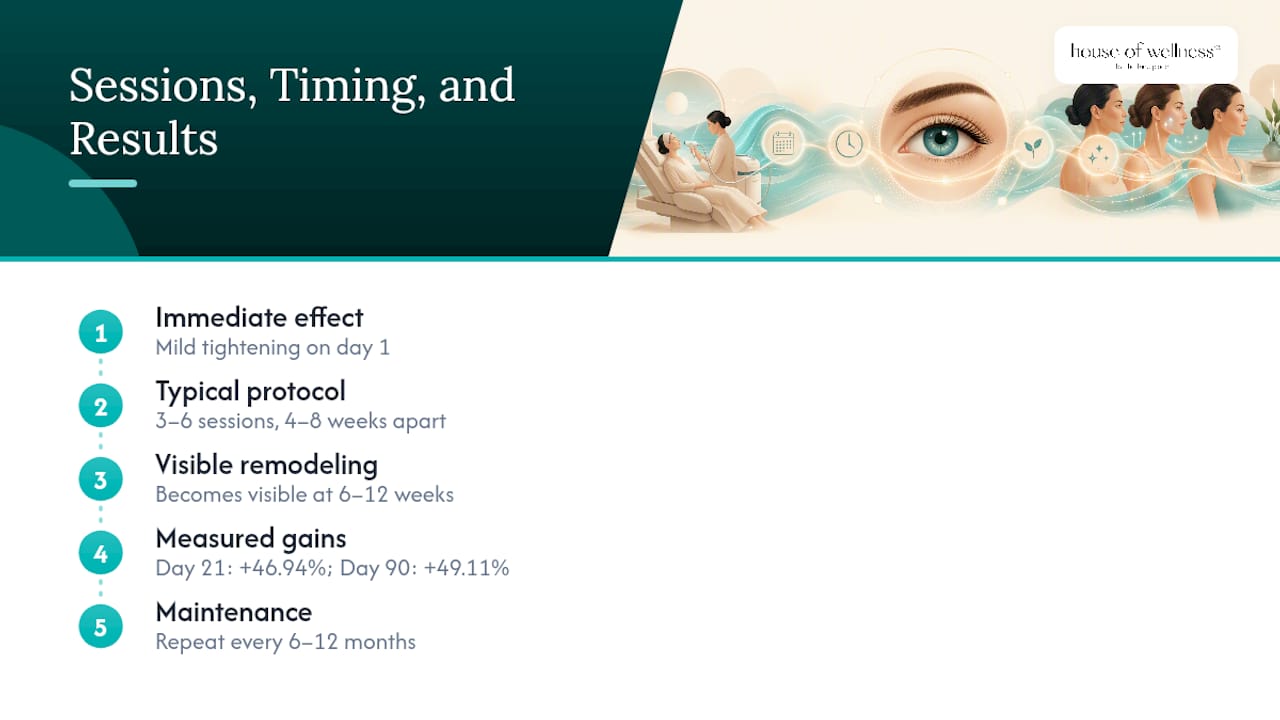
Most people need a series, not a single visit, to see real change. Immediate mild tightening happens on day one, but the collagen remodeling that produces a genuine lift takes six to twelve weeks to become visible, with continued improvement through three to six months.

Typical protocols run three to six sessions spaced four to eight weeks apart, though some plasma RF devices show change after a single treatment. The Plasma IQ study recorded a 46.94% increase in upper eyelid margin distance at day 21, climbing to 49.11% by day 90, meaning results kept building well after the appointment ended. Maintenance sessions every six to twelve months are common once you reach your target result.
Is RF Safe for the Delicate Skin Around Your Eyes?
RF treatment near the eyes is generally safe when a trained operator uses proper eye protection and temperature control, and the research backs a reassuring safety profile across skin types. A broader review of RF facial rejuvenation describes RF as low risk for pigment changes across different skin tones, though it stresses that protocols aren't standardized industry wide, which puts real weight on operator skill.
Expect mild redness, temporary swelling, or slight tenderness after a session. These typically resolve within a day or two. Rarer risks include thermal injury if temperature control fails, transient pigment shifts, or prolonged swelling, and these almost always trace back to inadequate safety equipment or an undertrained operator.
Clinics that do this well combine a few specific safeguards: autoclavable opaque plastic scleral shields that physically block the globe from RF exposure, real time temperature feedback so energy never exceeds a safe threshold, and conservative settings tailored to the thin skin of the eyelid. Bipolar RF research backs this approach directly, showing that controlled heating rather than thermal damage is what produces rejuvenation without harming tissue.
The goal is thermal stimulation, not thermal damage. That distinction, backed by real time temperature feedback, is what separates a safe periocular RF protocol from a risky one.
Pro Tip: Ask the clinic to walk you through their eye protection protocol before you book. If they can't clearly explain how they control temperature or protect your eyes, keep looking.
Who Is a Good Candidate for RF Eye Treatment?
You're likely a good candidate if you have mild to moderate skin laxity, crepey or thinning skin around the eyes, and fine lines, but no significant fat prolapse or excess skin, which usually needs surgical blepharoplasty instead.
- Active infection, inflammation, or open wounds in the treatment area rule out RF until healed.
- Recent isotretinoin use, pregnancy, and certain implanted electronic devices are common contraindications worth flagging at consultation.
- Best responses often show up in patients in their 30s through 60s who still have some residual skin elasticity, though your specific anatomy matters more than your age on paper.
- Bring photos of your concerns and a list of current medications to your first visit so the clinic can plan around your history.
How Do You Choose a Clinic for RF Eye Treatment?
Prioritize clinics that can speak fluently about their device, their temperature control protocol, and their eye protection procedure, and that back their claims with photographic documentation using objective measures rather than flattering lighting alone.
- Confirm licensed medical oversight or trained medical staff administer the treatment, not just an aesthetician following a script.
- Ask which device category they use, monopolar, bipolar, or fractional, and why that fits your goals specifically.
- Request a written protocol for eye protection and ask to see real before-and-after documentation.
- Get a clear session schedule, an honest maintenance timeline, and transparent pricing before you commit.
Questions worth asking directly: Which RF device and settings will you use around my eyes? Do you use temperature feedback or physical eye shields? How many sessions do you recommend, and what results should I realistically expect? What side effects are common, and how do you manage them?
A clinic that welcomes these questions and answers them specifically, not vaguely, is telling you something important about how seriously they take safety.
What Aftercare Does RF Eye Treatment Require?
Aftercare is minimal. Most clinics recommend sun protection, gentle skincare, and skipping strong active ingredients like retinoids for a few days after your session.
- Use cold compresses if you notice swelling in the hours after treatment.
- Avoid intense heat, saunas, and hard exercise for 24 to 48 hours.
- Wear sunscreen daily, especially on treated skin that's temporarily more sensitive.
- Follow whatever product recommendations your clinic gives you rather than reaching for your usual routine immediately.
Clinics often pair RF with hyaluronic acid boosters or microneedling to extend results, staging the combination so inflammation from one treatment doesn't compound the other. A common sequence runs the RF series first, then introduces HA hydration boosters once the skin has settled.
Pro Tip: If your clinic suggests combining RF with another treatment, ask them to explain the timing rationale. A staggered plan, not a same-day stack, is usually the safer approach.
Why House of Wellness Takes an Evidence-First Approach
We built our approach to radiofrequency around one idea: results should be measurable, not just felt. That means integrating RF into a calming spa experience without cutting corners on medical oversight or protective protocol.
Every treatment plan is customized to your anatomy and goals, pairing RF with medical-grade skincare and, where it makes sense, complementary therapies. If you're weighing your options, the best next step is a consultation where we can review your specific concerns and show you what realistic progress looks like for your skin.
Book Your Radiofrequency Eye Treatment Consultation
Houseofwellnesssg treats radiofrequency around the eyes as a medical-adjacent procedure wrapped in a genuinely relaxing spa experience, not a quick add-on squeezed between other services. Every session starts with a real consultation, mapping your specific areas of concern and walking through consent before any device touches your skin.

At your appointment, expect a conversation first: what bothers you, what you're hoping to see, and an honest read on whether RF is the right fit. From there, we use conservative periocular settings suited to the thin skin around your eyes, paired with the temperature control and protective measures covered earlier in this guide. Aftercare guidance and a follow-up plan come standard, not as an afterthought.
If you want to see how radiofrequency treatments fit your skin specifically, or you're curious how RF pairs with microcurrent work for a more complete periocular refresh, the next step is simple: book a consultation and bring your questions. We'll answer them directly, show you what objective progress looks like, and build a plan around your anatomy rather than a one-size-fits-all package.
Selected Research on RF Eye Treatments
- Nonablative RF treatment for the eye area: documents the 33.26% photodocumentation improvement referenced above, with cutometer data confirming objective skin changes.
- Plasma IQ periorbital rejuvenation study: measures elasticity and eyelid margin distance gains using instrumented, not subjective, evaluation.
- Monopolar RF eyelid tightening in Asian patients: reports high patient-reported improvement rates with no adverse events across the study cohort.
- RF facial rejuvenation mechanisms review: explains collagen remodeling across monopolar, bipolar, and fractional RF categories.
Ask your clinician about cutometry and photodocumentation. These are the same objective measures used in the studies above.
Frequently Asked Questions
Does radiofrequency eye treatment actually tighten skin, or is it just marketing? The evidence points to real, measurable change.
Is RF around the eyes painful? Most patients describe a warm, tingling sensation rather than pain. Temperature-controlled devices keep heat within a safe, tolerable range throughout the session.
How soon will I see results from RF eye treatment? Mild tightening can appear immediately due to collagen contraction, but the fuller remodeling effect typically shows between 6 and 12 weeks, with continued improvement through 3 to 6 months.
Can RF eye treatment replace eyelid surgery? No. RF works well for mild to moderate laxity and fine lines, but significant excess skin or fat prolapse generally requires surgical blepharoplasty.
How do I know a clinic is using RF safely around my eyes? Ask specifically about temperature control and opaque eye shields. A clinic that can't explain their protective protocol in detail is a red flag, regardless of how advanced their device sounds.
This article is general information, not a substitute for advice from a qualified doctor. Consult a qualified healthcare professional about your own circumstances before acting on anything here.
Sources
- Nonablative radiofrequency treatment for the skin in the eye area – clinical and cutometrical analysis
- Clinical and instrument-based evaluation of Plasma IQ microcurrent radiofrequency for periorbital skin rejuvenation
- Tightening of the eyelids with monopolar radiofrequency in Asians