
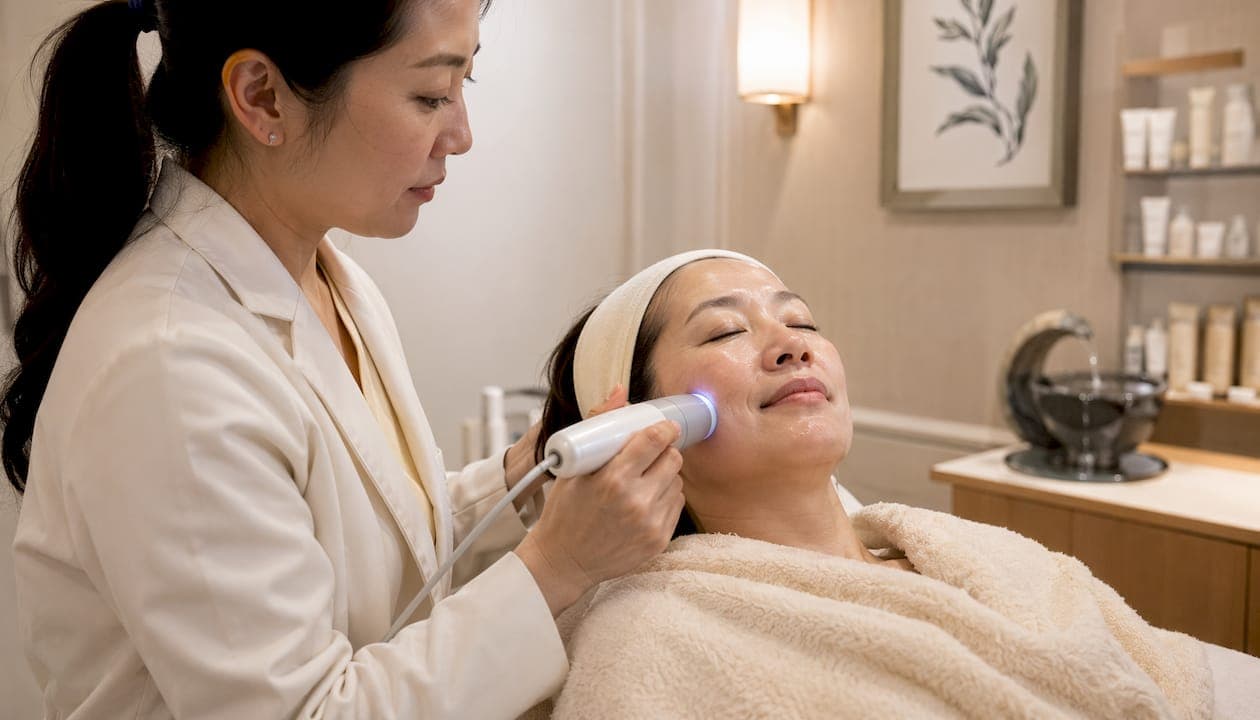
RF facials deliver noninvasive skin tightening, improved texture, and gradual collagen regeneration — all without surgery, significant downtime, or the risks that come with more aggressive procedures. Clinical evidence confirms that radiofrequency energy triggers neocollagenesis deep in the dermis, and the Cleveland Clinic notes it as a safe, effective option for mild-to-moderate laxity. For Singapore residents, Houseofwellnesssg offers these treatments in a calm, personalized setting designed around your skin and your comfort.
Here is what RF facials can do for you:
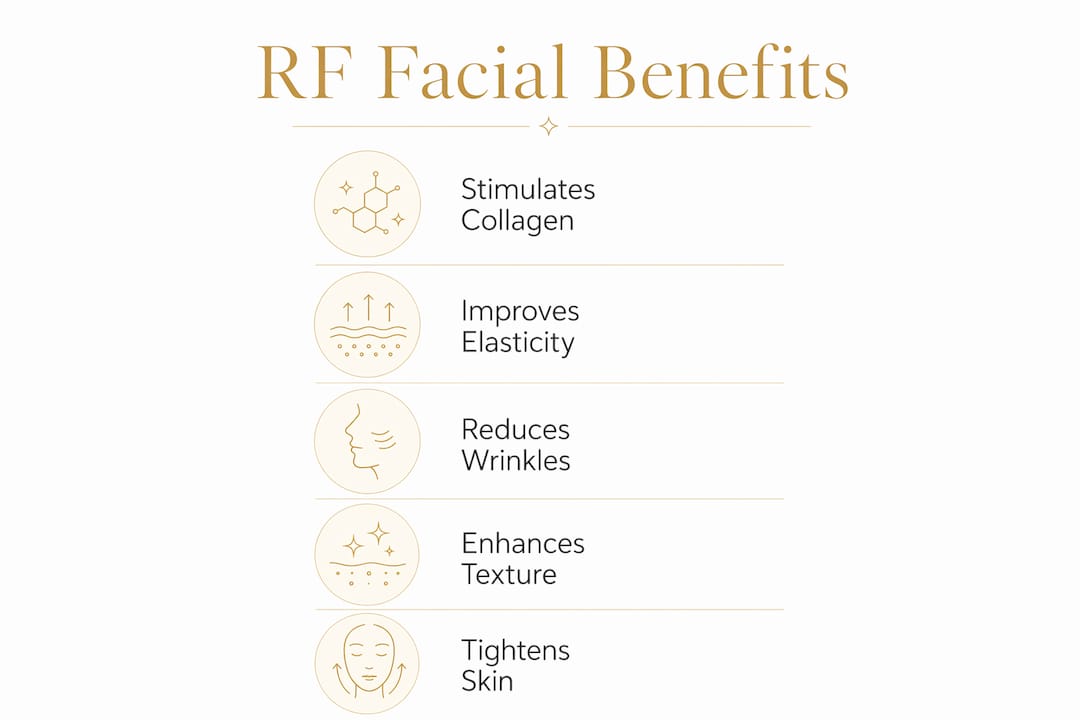
- Skin tightening — firmer, lifted contours, often noticeable after the first session
- Reduced fine lines and wrinkles — especially periocular lines and forehead creasing
- Improved skin texture and pore appearance — smoother surface with more even tone
- Subtle facial contouring — mild jawline and cheek definition over a course of treatments
- Collagen and elastin stimulation — new collagen builds gradually over 2–6 months
- Synergy with microneedling — RF microneedling adds texture correction and acne scar improvement on top of tightening
Table of Contents
- How RF energy heats your skin to rebuild collagen
- Concrete benefits you can expect from RF facials
- Types of RF treatments and which one fits your goal
- What to expect during a session, from prep to recovery
- Risks, side effects, and how to stay safe in Singapore
- Who benefits most from RF, and who should wait
- When you'll see results and how to maintain them
- RF vs HIFU: how to choose between the two technologies
- RF as a prejuvenation strategy for Singapore skin
- Key Takeaways
- Why RF fits so many of the clients we see at Houseofwellnesssg
- RF facials at Houseofwellnesssg: what we offer and how to book
- Useful sources and further reading
How RF energy heats your skin to rebuild collagen
Radiofrequency energy works by delivering controlled electrical current into the dermis, where it converts to heat through the natural resistance of tissue. That thermal effect is the key. When dermal temperature reaches the therapeutic range, collagen fibers contract immediately, producing a subtle tightening you can feel right after a session. More importantly, the heat activates fibroblasts — the cells responsible for producing collagen, elastin, and hyaluronic acid — triggering a repair response that generates new, more organized collagen over the following weeks.
Research identifies approximately 67°C as the dermal target temperature that optimizes collagen remodeling. Reaching that threshold safely, without overheating the epidermis above it, is what separates a well-calibrated RF session from one that risks surface burns. A separate PMC study on bipolar RF found that thermal stimulation alone — without causing thermal damage — is sufficient to produce measurable rejuvenation effects, with collagen proliferation visible within two weeks of treatment.
Two things happen on different timelines. Immediately after a session, you may notice a subtle firmness from collagen fiber contraction. The more meaningful improvement — new collagen formation, or neocollagenesis — peaks around 2–6 months post-treatment. That delayed payoff is why a single session rarely tells the whole story, and why a course of treatments produces compounding results.
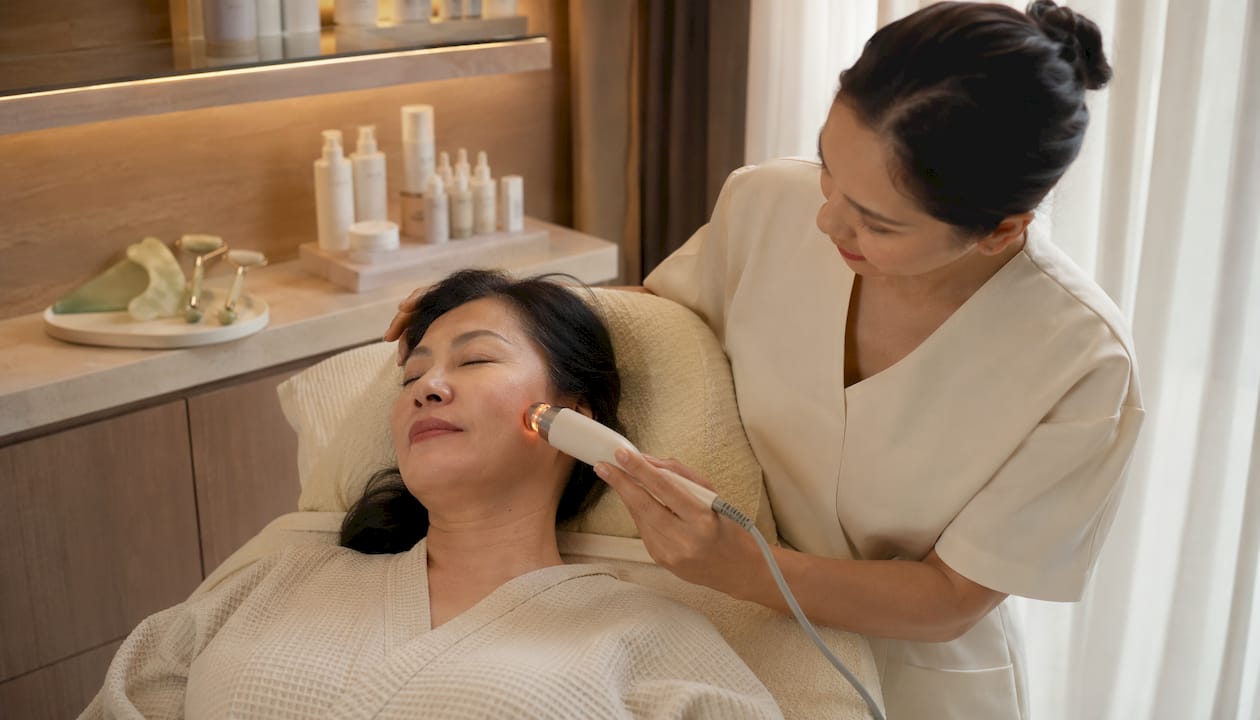
Monopolar RF delivers energy through a single electrode, with a grounding pad placed elsewhere on the body. This allows deeper, more uniform penetration. Bipolar RF completes the circuit between two electrodes on the handpiece itself, limiting depth but offering more controlled, surface-focused heating. Both approaches stimulate collagen; the difference is where in the tissue that stimulation occurs.
Concrete benefits you can expect from RF facials
The primary outcomes of RF skin rejuvenation are well-documented, but the timeline matters as much as the result itself. Here is a realistic look at what each benefit involves:
- Skin tightening: The most consistent outcome across studies. Immediate firmness comes from collagen contraction; longer-term lifting from new collagen formation. Expect the most noticeable tightening at 2–3 months after a course of sessions.
- Reduced fine lines: A clinical trial of 46 patients using bipolar RF showed statistically significant improvement in wrinkles, laxity, texture, and pore size, with particularly strong results on periocular fine lines and frown lines.
- Improved texture and pore appearance: RF smooths the skin surface by reorganizing collagen architecture beneath it. Pore size reduction is a secondary benefit, not the primary mechanism — so results here are real but modest.
- Subtle contouring: Some studies report clinically meaningful improvements in facial contouring after multiple sessions over weeks to months. RF will not replicate a surgical result, but it can soften jowling and define the jawline gently.
- Collagen and elastin production: RF stimulates fibroblasts to produce new collagen and elastin, with hyaluronic acid as a secondary benefit. This is the foundation of RF's anti-aging value.
- Gradual, natural-looking change: Because results build over months, the improvement looks like your own skin improving — not a sudden, obvious procedure. For many people in Singapore, that subtlety is exactly what they want.
One expectation to calibrate: RF is most effective for mild-to-moderate laxity. If sagging is significant, RF alone may not deliver the lift you are hoping for, and a consultation with a clinician will help you understand whether RF, a deeper-energy device, or a combination approach is the right fit.

Types of RF treatments and which one fits your goal
Not all RF devices work the same way, and choosing the right type makes a real difference in what you get from treatment.
- Monopolar RF: Deepest penetration, uniform energy spread. Best for overall facial tightening and body laxity. Systematic review evidence confirms measurable improvements in facial and body laxity, though monopolar devices showed higher major-complication rates than bipolar in reviewed studies — making practitioner skill and device calibration especially important.
- Bipolar RF: Shallower, more controlled heating between two electrodes. Well-suited for fine lines, surface texture, and areas where precision matters more than depth. Generally a gentler experience with a favorable safety profile.
- Fractional RF: Energy is delivered in a grid pattern, creating discrete thermal zones surrounded by untreated tissue. This fractional approach accelerates healing and allows for more aggressive settings with less overall surface disruption.
- RF microneedling: Combines the mechanical channels of microneedling with RF energy delivered directly into the dermis via insulated needles. This produces focal thermal injury at discrete regions alongside microneedling channels, making it more effective for acne scarring and texture than noninvasive RF alone. If acne scars or significant texture irregularity are your primary concern, RF microneedling is typically the stronger choice. You can explore standard microneedling options as a comparison point when discussing your goals with a clinician.
Quick use-case guide:
| Goal | Recommended RF type |
|---|---|
| Overall facial tightening | Monopolar or bipolar RF |
| Fine lines and surface texture | Bipolar RF |
| Acne scarring and deeper texture | RF microneedling |
| Body laxity and contouring | Monopolar RF or body RF |
| Prejuvenation (early prevention) | Bipolar or monopolar RF |
Pro Tip: If you have darker skin (Fitzpatrick types IV–VI, common across Singapore's diverse population), ask your clinician specifically about device settings and whether a test patch is planned. RF energy is not absorbed by melanin, so it is broadly usable across skin tones — but parameter calibration still matters for your safety.
What to expect during a session, from prep to recovery
A typical RF facial session is shorter and more comfortable than many people expect. Here is how a session generally unfolds:
| Phase | What happens | Approximate time |
|---|---|---|
| Pre-treatment check | Skin assessment, cleanse, numbing cream (for RF microneedling) | 30 min |
| Procedure | RF handpiece passed over treatment areas with cooling gel | 20 min |
| Immediate post-care | Soothing serum or mask, SPF applied | — |
| Recovery | Mild redness, possible warmth; most people return to normal activities same day | 24–48 hours |
| Follow-up | Next session typically 2–4 weeks later, depending on protocol | Ongoing |
Pain levels differ between device types. Noninvasive RF (monopolar or bipolar surface devices) feels warm, sometimes intensely so, but is generally tolerable without numbing. RF microneedling involves needle penetration, so topical anesthetic is standard and makes the procedure comfortable for most people.
Aftercare steps to protect your results:
- Apply broad-spectrum SPF 50 every morning — Singapore's UV index makes this non-negotiable after any thermal treatment
- Keep skin hydrated with a gentle, fragrance-free moisturizer for the first week
- Avoid active ingredients (retinoids, AHAs, BHAs) for 5–7 days post-treatment
- Skip intense heat exposure (saunas, hot yoga) for 48 hours
- A hydrating facial in the days before your RF session can prep the skin barrier and improve comfort during treatment
Risks, side effects, and how to stay safe in Singapore
RF is generally low-risk, but knowing what to watch for helps you choose a clinic and practitioner with confidence.
Common side effects (usually resolve within 24–72 hours):
- Redness and warmth immediately after treatment
- Mild swelling, particularly around the eyes
- Temporary sensitivity or tingling
Less common but possible:
- Transient burns or blistering if energy is too high or cooling is inadequate
- Hyperpigmentation, particularly in darker skin tones without proper parameter calibration
- Rare: scarring or skin surface irregularities from uneven energy application
Darker skin tones benefit from RF's physics — RF energy is not absorbed by melanin — but practitioners should still calibrate settings carefully and consider test patches to reduce hyperpigmentation risk. In Singapore, where Fitzpatrick types III–V are common, this precaution is standard good practice, not an afterthought.
Contraindications — RF is not appropriate if you have:
- Active skin infection, open wounds, or severe acne cysts in the treatment area
- A pacemaker, implanted defibrillator, or metal plates in the face
- Pregnancy
- Recent isotretinoin use (typically wait 6 months after completing a course)
- Uncontrolled diabetes or autoimmune conditions affecting skin healing
Risk-reduction checklist for Singapore clients:
- Confirm your practitioner has training and experience with the specific device being used
- Ask whether the device is approved for use in Singapore under the Health Sciences Authority (HSA) framework
- Request a patch test if you have darker skin or a history of post-inflammatory hyperpigmentation
- Verify that the clinic uses vacuum-assisted or evenly scanning handpieces to reduce the risk of localized energy concentration
- Ensure cooling is applied throughout the session to protect the epidermis
Pro Tip: A reputable clinic will welcome these questions. If a provider seems reluctant to discuss device credentials or practitioner qualifications, that is a clear signal to look elsewhere.
Who benefits most from RF, and who should wait
RF facials suit a wide range of people, but they are not the right fit for everyone.
You are likely a good candidate if you:
- Have early-to-moderate signs of skin laxity (mild jowling, softening jawline, early neck laxity)
- Want to address fine lines and surface texture without surgery or significant downtime
- Are interested in prejuvenation — starting treatments before significant sagging develops
- Have realistic expectations about gradual, natural-looking improvement
- Are in generally good health with no active skin conditions in the treatment area
Consider waiting or seeking alternatives if you:
- Have significant, advanced sagging that would realistically require surgical correction
- Are pregnant or breastfeeding
- Have active cystic acne, open wounds, or an active skin infection
- Have metal implants or a pacemaker
- Recently finished isotretinoin (wait at least 6 months)
- Have uncontrolled medical conditions that affect skin healing
For those with darker skin tones or a complex medical history, a consultation with a licensed clinician before booking is the right first step. RF treatments can be adapted for many skin types, but personalized assessment protects both your safety and your results.
When you'll see results and how to maintain them
Some tightening is immediate, from collagen fiber contraction during the session itself. The more meaningful collagen-driven improvement builds over 2–6 months as new collagen matures. Results from a well-structured course of treatments can last up to 1–2 years, depending on the device, the number of sessions, your skin's baseline, and how consistently you protect and maintain your skin afterward.
Typical session cadence:
- Initial course: 3–6 sessions spaced 2–4 weeks apart, depending on the device and your skin goals
- Maintenance: Annual or biannual sessions to sustain collagen levels and slow progressive laxity
- Prejuvenation approach: Annual or biannual sessions starting in your late 20s or 30s, before significant laxity develops
| Timeframe | What you experience |
|---|---|
| Immediately after | Subtle warmth, mild firmness, possible redness |
| 2–4 weeks | Redness resolves; skin feels slightly smoother |
| 2–3 months | Noticeable tightening and texture improvement as new collagen matures |
| 4–6 months | Peak collagen-driven results; best time to assess and plan next steps |
| 12–24 months | Results begin to soften without maintenance; a top-up session sustains improvement |
Pairing RF with daily SPF 50, a retinoid (once skin has fully recovered post-treatment), and a consistent hydration routine extends results meaningfully. Singapore's year-round UV exposure accelerates collagen breakdown, so sun protection is not optional — it is part of the treatment plan.
RF vs HIFU: how to choose between the two technologies
This is one of the most common questions people ask before booking, and the answer comes down to depth and what you are trying to correct.
RF heats the dermis and upper subcutaneous tissue. It is well-suited for surface tightening, texture improvement, fine lines, and mild-to-moderate laxity. Sessions are generally more comfortable, and the gradual collagen-building effect suits people who want natural-looking results over time.
HIFU (High-Intensity Focused Ultrasound) targets deeper tissue layers, including the superficial musculoaponeurotic system (SMAS) — the same layer addressed in a surgical facelift. It is better suited for more significant descent from deeper structural layers, particularly in the mid-face and neck.
Side-by-side comparison:
- Depth: RF targets dermis and upper subcutis; HIFU reaches SMAS layer
- Best for: RF excels at texture, fine lines, and mild laxity; HIFU addresses deeper structural sagging
- Pain level: RF is generally more comfortable; HIFU can be more intense, particularly over bony areas
- Downtime: Both are minimal, though HIFU may produce more swelling in the days following
- Candidate fit: RF suits a broader age range and earlier-stage concerns; HIFU is often chosen for more advanced laxity
Simple decision rule: If your primary concern is fine lines, texture, or early laxity, RF is usually the better starting point. If you are noticing significant jowling or mid-face descent that has not responded to surface treatments, HIFU or a combination approach may serve you better. A clinician can assess which technology, or which combination, fits your specific anatomy.
RF as a prejuvenation strategy for Singapore skin
Experts increasingly frame RF not just as a corrective treatment but as a prejuvenation tool — a way to preserve collagen integrity before significant laxity develops, rather than waiting to correct it afterward. The concept of "collagen banking" captures this well: regular, earlier treatments maintain dermal collagen architecture and elasticity, shifting the goal from repair to prevention.
For Singapore skin specifically, a few factors shape how RF fits into a long-term skin health plan:
- UV exposure: Singapore's equatorial climate means year-round high UV, which accelerates collagen degradation. RF-stimulated neocollagenesis can partially offset this, but only when paired with consistent daily SPF 50.
- Skin tone diversity: Singapore's population spans Fitzpatrick types II–VI. RF's physics — energy not absorbed by melanin — make it broadly accessible, but calibrated settings and test patches remain important for types IV and above.
- Humidity and skin barrier: High humidity can support skin hydration but also increases sensitivity post-treatment. Gentle aftercare and avoiding harsh actives for the first week are especially relevant here.
- Combination approaches: RF pairs well with red light therapy for recovery support, and with microcurrent sculpting for added lift and contouring. At Houseofwellnesssg, these modalities can be integrated into a single wellness plan tailored to your skin's needs.
"Monopolar RF stimulates neocollagenesis and may be effective as a prejuvenation strategy — histological and clinical studies show it induces collagen remodeling and increased collagen content, with experts suggesting repeated treatments every 1–2 years may help prevent sagging." — PMC, Monopolar Radiofrequency for Dermal Prejuvenation
A practical prejuvenation plan for Singapore clients might look like this: begin a course of several RF sessions in your late 20s or early 30s, maintain with periodic sessions, pair with daily SPF and a retinoid (used on non-treatment nights), and complement with RF technology's growing role in modern med-spa and wellness clinic protocols. Starting early, staying consistent, and protecting your skin between sessions is what makes the difference over the long term.
Key Takeaways
RF facials deliver noninvasive skin tightening and collagen regeneration that build gradually over 2–6 months, making them one of the most practical non-surgical rejuvenation options for Singapore skin.
| Point | Details |
|---|---|
| Mechanism and timing | RF heats the dermis to trigger collagen remodeling; peak results appear at 2–6 months post-treatment. |
| Best candidates | Those with mild-to-moderate laxity, fine lines, or texture concerns benefit most; severe sagging may need deeper-energy options. |
| Safety across skin tones | RF energy is not absorbed by melanin, making it broadly usable, but calibrated settings and test patches are important for darker skin types. |
| Maintenance matters | Results last 1–2 years; annual or biannual top-up sessions sustain collagen levels and slow progressive laxity. |
| Houseofwellnesssg approach | Houseofwellnesssg offers customizable RF treatments in Singapore, integrated with complementary modalities for a personalized skin wellness plan. |
Why RF fits so many of the clients we see at Houseofwellnesssg
From the clinic's perspective, RF stands out because it meets people where they are. Most clients who come to us are not looking for dramatic transformation — they want their skin to look and feel like the best version of itself, without surgery, without a week of hiding at home, and without a one-size-fits-all protocol. RF delivers exactly that kind of result.
What we find most rewarding is the personalization it allows. A client in their late 20s starting RF for prevention gets a very different session plan than someone in their 40s addressing early jowling or texture changes from years of sun exposure. We integrate RF with microcurrent sculpting for clients who want added lift, or pair it with restorative facial protocols for those whose skin needs a gentler, more nurturing approach alongside the thermal work. Every plan is built around your skin, your lifestyle, and your comfort.
RF facials at Houseofwellnesssg: what we offer and how to book
Houseofwellnesssg brings you customizable RF and RF-adjacent treatments designed for Singapore skin and the realities of Singapore life — high UV, diverse skin tones, and a pace that leaves little room for extended recovery.

Our radiofrequency treatments are tailored to your skin's current condition and your long-term goals, whether you are starting a prejuvenation plan in your 20s or addressing visible laxity and texture changes now. Sessions can be combined with complementary services from our full treatment menu — including restorative facials, microcurrent sculpting, and red light therapy — so your skin gets exactly what it needs, nothing more and nothing less. No pressure, no unnecessary upsells, just thoughtful care in a calm, welcoming space at Tanjong Pagar. Book your consultation directly through our website to find the right treatment plan for you.
Useful sources and further reading
The following sources informed this article and are worth exploring if you want to go deeper on the clinical evidence or safety considerations:
- Monopolar Radiofrequency for Dermal Prejuvenation: Scientific Rationale and Mechanisms of Action — PMC — Primary evidence for neocollagenesis, collagen banking, and the prejuvenation framework
- Minimally Invasive Approach to Skin Tightening: Systematic Review of Monopolar and Bipolar RF Devices — PubMed — Systematic review of clinical outcomes and complication profiles across device types
- Radiofrequency Improves Facial Fine Lines by Thermal Effect — PMC — Clinical trial evidence on bipolar RF parameters, safety, and fine-line outcomes in a 46-patient study
- Radio Frequency (RF) Skin Tightening: Benefits and Dangers — Cleveland Clinic — Accessible clinical overview of RF safety, efficacy, and candidate guidance
- Does Radio Frequency Skin Tightening Work? Benefits and Side Effects — Healthline — Practical patient-facing summary with side-effect and skin-tone guidance
- Houseofwellnesssg Radiofrequency Service Page — Details on RF treatments available in Singapore at Houseofwellnesssg
This article is general information, not medical or clinical advice. For a personalized assessment of whether RF is right for your skin, consult a licensed clinician or dermatologist.