
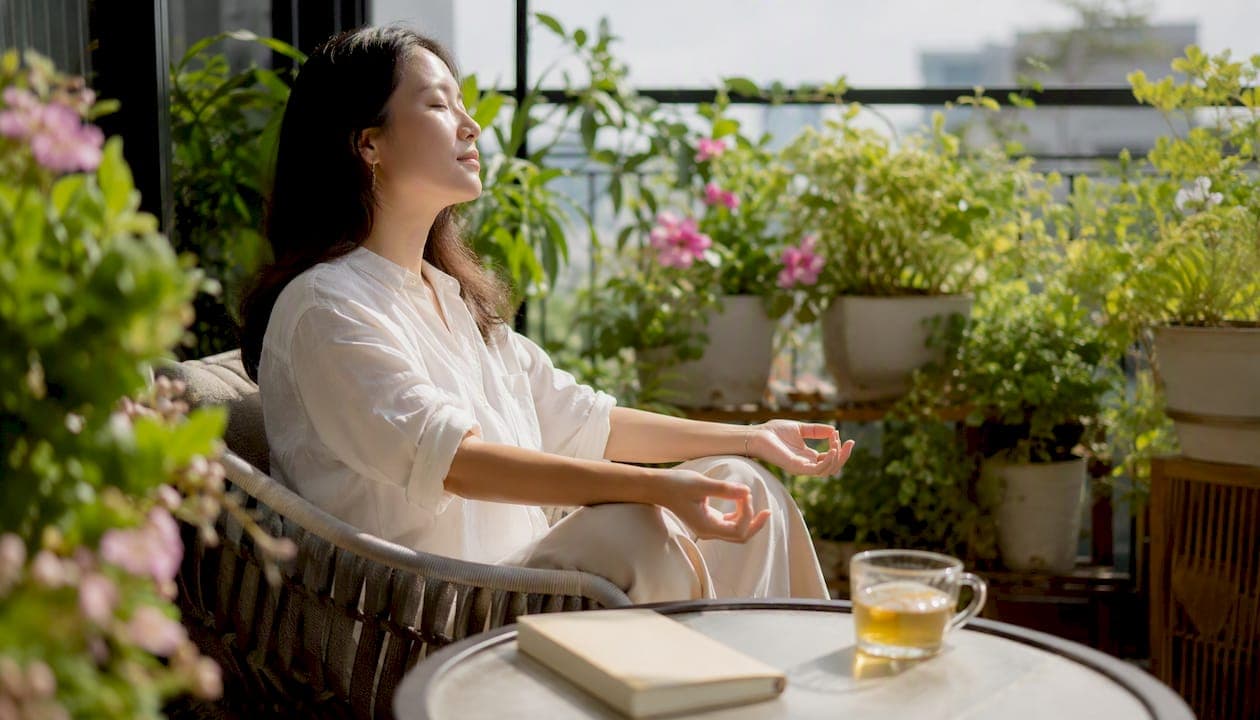
Short, repeatable stress relief rituals involving a few minutes of diaphragmatic breathing, a body scan, or hand massage reliably lower heart rate, ease muscle tension, and reduce perceived anxiety. You don't need a quiet room or a free afternoon. You need a sequence, a cue, and about five minutes.
Three options you can try right now:
- A brief breathing micro-ritual: Sit upright, breathe in slowly through your nose for several counts, hold briefly, exhale slowly. Repeat multiple rounds. Works at your desk, on the MRT, or before a meeting.
- 5-minute body scan: Close your eyes, breathe naturally, and move your attention slowly from your feet to the crown of your head. Notice tension without trying to fix it. Full script below.
- 2–3 minute hand massage or tea ritual: Press your thumb into the fleshy pad between your opposite thumb and index finger, hold for 5 seconds, release. Or simply hold a warm cup of tea with both hands and breathe in the steam before your first sip.
HealthHub Singapore confirms that micro-rituals lasting only a few minutes are practical and effective for busy professionals. The key is repetition, not duration.
Table of Contents
- What stress relief rituals can you do anywhere in 3–5 minutes?
- Guided practice scripts: body scan, PMR, and breathwork
- How do sensory rituals help you recover from stress?
- Simple movement rituals that clear your head fast
- How do you build a stress-relief ritual you'll actually keep?
- Why do rituals actually reduce physiological stress?
- When are rituals unhelpful, and when should you seek help?
- Key Takeaways
- A clinic note on rituals and restorative care
- Houseofwellnesssg: restorative in-person sessions in Singapore
- Useful sources and further reading
What stress relief rituals can you do anywhere in 3–5 minutes?
The best calming activities for a packed Singapore workday are the ones you can do without leaving your chair or drawing attention. These micro-rituals are designed for exactly that.

Box breathing (4-4-4 sequence)
Sit with your feet flat on the floor. Rest your hands on your thighs. Breathe in through your nose for a few counts, hold briefly, exhale slowly through your mouth, and pause. That's one round. Repeat several rounds, totaling a few minutes. Your shoulders will drop noticeably by round three.
60-second body awareness check
You don't need 5 minutes to reset. Close your eyes for one minute. Notice where your body touches the chair. Feel your feet on the floor. Take three slow breaths and name one sensation in each body area: feet, belly, shoulders, jaw. Open your eyes. That's it.
Desk hand massage
Place your left hand palm-up. Use your right thumb to press slowly along the center of your palm from the base to each finger. Spend 20 seconds on each hand. The pressure activates sensory nerve pathways that signal safety to your nervous system. No oils, no noise, no explanation needed to anyone nearby.
Tea ritual at your desk
Before your next cup of tea or coffee, pause. Hold the cup with both hands. Feel the warmth. Inhale the steam for three slow breaths before you sip. This 90-second pause shifts your attention from task mode to sensory presence, which is exactly what the nervous system needs to begin recovering.
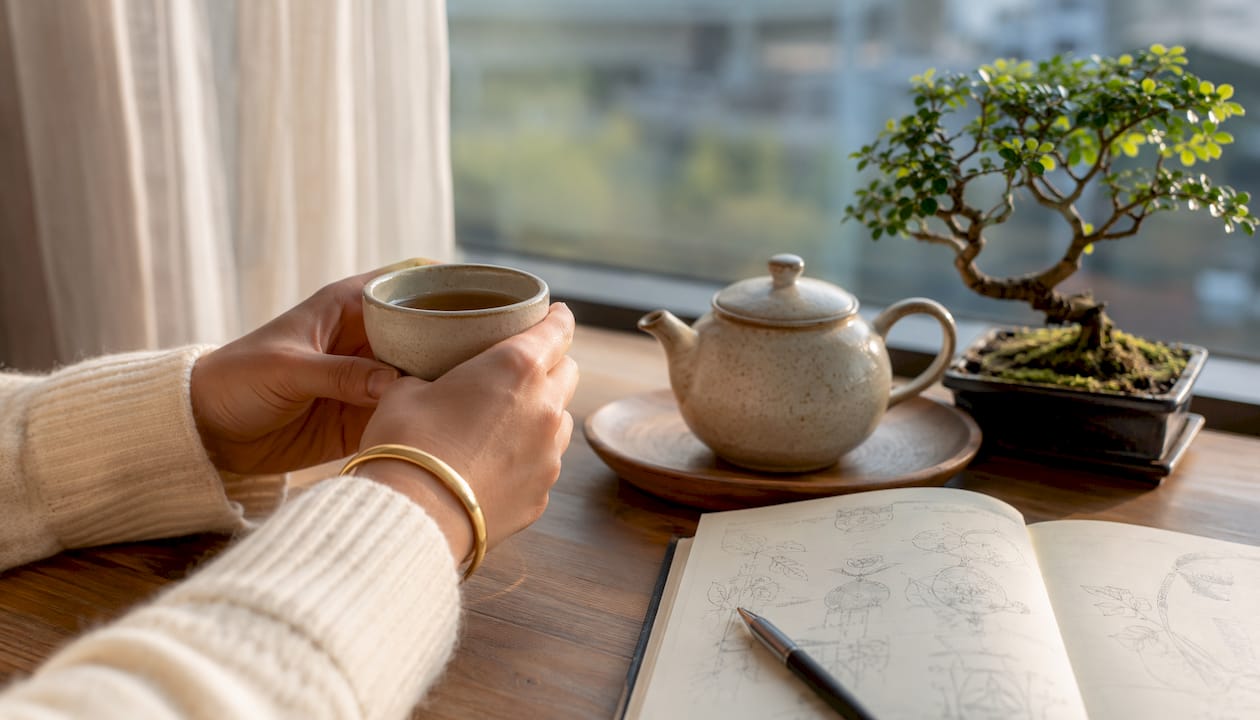
Pro Tip: Anchor one micro-ritual to an existing habit — right after you send a report, right before you join a video call. Embedding a ritual into an everyday task makes it far more sustainable than carving out new time blocks.
Guided practice scripts: body scan, PMR, and breathwork
These three evidence-based guided practices are the backbone of most relaxation programs. You can read them aloud to yourself, record them on your phone, or follow along silently.
5-minute body scan (seated or lying)
Best for: mid-afternoon tension, before sleep, or after a difficult meeting.
- Sit comfortably or lie flat. Close your eyes. Take three natural breaths.
- Bring your attention to the soles of your feet. Notice any warmth, pressure, or tingling. Stay here for 20 seconds.
- Move your attention slowly up through your calves, knees, and thighs. Don't try to relax anything — just notice.
- Shift to your belly. Feel it rise and fall with each breath. Stay for 20 seconds.
- Move to your chest, then your shoulders. If you notice tightness, breathe toward it gently.
- Scan your neck, jaw, and the muscles around your eyes. Let your jaw drop slightly.
- Finish at the crown of your head. Take three slow breaths. Open your eyes.
Brief body scans like this create measurable relaxation responses and improved mental clarity, even in a single session.
Progressive muscle relaxation (shortened version)
Mayo Clinic recommends tensing each muscle group for approximately 5 seconds, then releasing for 30 seconds. Here's a 5-minute version you can do seated:
- Hands: Clench both fists tightly for 5 seconds. Release. Feel the warmth spread for 30 seconds.
- Shoulders: Shrug them up toward your ears for 5 seconds. Drop them. Breathe out slowly.
- Face: Scrunch your entire face — forehead, eyes, jaw — for 5 seconds. Release. Notice the softening.
- Legs: Press both feet firmly into the floor for 5 seconds. Release.
- Full body: Take one deep breath, tense everything at once for 5 seconds, then exhale and let go completely.
Breathwork: diaphragmatic and box variants
Diaphragmatic breathing (belly breathing): Place one hand on your chest, one on your belly. Inhale through your nose so your belly hand rises but your chest hand stays still. Exhale slowly. This is the technique that produces measurable reductions in heart rate and cortisol — a single session of slow diaphragmatic breathing can lower salivary cortisol within 10–20 minutes.
Box breathing (4-4-4-4): Inhale for 4 counts, hold for 4, exhale for 4, hold empty for 4. Repeat multiple rounds. Use this before high-stakes situations: a presentation, a difficult conversation, or a commute home after a hard day.
4-7-8 breathing: Inhale for 4 counts, hold for 7, exhale slowly for 8. This longer exhale activates the parasympathetic nervous system more strongly. Use it at night when your mind won't quiet down.
Signs the practice is working: your breath slows on its own, your shoulders drop, and the mental chatter softens. You don't need to feel "blissed out" — a slight sense of physical heaviness or warmth is enough.
How do sensory rituals help you recover from stress?
Touch, scent, and warmth are among the fastest routes to nervous system recovery. Sensory cues work as anchors: a predictable sensory input paired with a breathing sequence trains your body to shift from threat mode to rest mode more quickly each time you repeat it.
Step-by-step hand massage
You can do this at your desk in under 3 minutes. No equipment needed.
- Hold your left hand palm-up in your right hand.
- Use your right thumb to press firmly into the center of your left palm. Hold for 5 seconds, release.
- Work your thumb slowly from the base of each finger to the fingertip, applying steady pressure.
- Squeeze gently along the outer edge of your hand from the pinky to the wrist.
- Switch hands and repeat.
The pressure on the palm's center (near the pericardium 8 acupressure point) is used in traditional Chinese medicine to calm the mind. Whether or not you subscribe to that framework, the tactile input itself is grounding.
Mindful tea ritual
Brewing and sipping tea mindfully is one of the most accessible wellness rituals for Singapore's office culture, where a cup of teh or green tea is already part of the daily rhythm.
Boil water to an appropriate temperature for your tea, then pour slowly. Watch the color bloom. Hold the cup with both hands and inhale the steam for three full breaths before you sip. With each sip, pause. Notice the temperature, the taste, the sensation in your throat. Five minutes of this replaces five minutes of scrolling — and the physiological effect is measurably different.
Aromatherapy: what works and how to use it safely
Lavender, bergamot, and chamomile are the most studied scent families for relaxation. In Singapore's shared office spaces and public areas, be considerate: use a personal inhaler stick or a small roll-on rather than a diffuser. Apply diluted essential oils (always mixed with a carrier oil like jojoba or sweet almond) to your wrists or the back of your neck. Never apply undiluted essential oils directly to skin, and avoid strong scents in enclosed spaces where colleagues may have sensitivities or allergies.
If scent or touch isn't accessible to you (skin conditions, sensory sensitivities, or simply a crowded train), temperature works just as well. A cold glass of water held in both hands, or a warm compress on the back of your neck, delivers a comparable sensory anchor.
Pro Tip: Pairing a consistent scent with your breathing ritual strengthens the anchor over time. After a few weeks, just inhaling that scent begins to trigger the relaxation response on its own — even before you start breathing deliberately. For a skin-nourishing option, a copper peptide anti-aging serum applied slowly as part of a morning face ritual can double as a grounding sensory practice.
Simple movement rituals that clear your head fast
Movement is one of the most underused stress management methods available to you, especially in Singapore's desk-heavy work culture. You don't need a gym or a yoga mat.
Mindful walking ritual
Step outside your building for a short walk. Walk at a pace slightly slower than your usual. Notice five things you can see, three you can hear, and one you can feel (the air on your skin, the ground under your feet). This structured attention practice interrupts the stress-thought loop more effectively than an unfocused walk. Brief walks and changes of scenery are endorsed by Mental Health First Aid as immediate interventions for a stressful day.
3–5 minute standing qigong-style stretch sequence
This sequence works in any space with enough room to extend your arms.
- Shoulder rolls: Roll both shoulders backward several times, then forward several times. Breathe in during the backward rolls and out during the forward rolls.
- Neck release: Drop your right ear toward your right shoulder. Hold for several slow breaths. Switch sides.
- Arm swing: Let both arms hang loose and swing gently side to side as you rotate your torso. 20 swings. Keep your knees soft.
- Standing forward fold: Hinge at the hips, let your head hang heavy, and hold for 5 breaths. Come up slowly.
- Wrist and hand shake: Shake both hands loosely for 10 seconds to release accumulated tension from typing.
Seated posture reset (2 minutes)
For moments when you can't stand up: sit at the front edge of your chair. Place both feet flat on the floor. Roll your pelvis forward so your lower back has a gentle curve. Lift the crown of your head toward the ceiling. Take several slow breaths in this position. This single adjustment opens the chest, reduces shoulder compression, and resets your breathing pattern.
Timing guidance: movement rituals work best before a high-pressure meeting, during the mid-afternoon energy dip (around 2–4 PM), or immediately after a stressful interaction. For those with joint conditions, balance issues, or recent injuries, modify or skip any movement that causes discomfort and consult your doctor before starting a new physical routine.
How do you build a stress-relief ritual you'll actually keep?
The most effective relaxation exercises are the ones you repeat. A ritual that takes 3 minutes and happens daily produces more durable change than a 30-minute session you do once a month.
The four-part ritual framework
Every sustainable ritual has four components:
- Trigger (cue): A specific, recurring moment that signals it's time. After your morning coffee. Before your first meeting. When you sit down on the MRT.
- Sequence: 3–5 steps in a fixed order. The predictability is the point — rituals lower heart rate and self-reported anxiety partly because their predictable structure gives you a sense of control.
- Sensory anchor: One consistent sensory cue (a scent, a specific mug, a particular chair) that your nervous system learns to associate with recovery.
- Closure: A brief, deliberate ending — three slow breaths, a gentle hand press on your thighs, or a quiet moment of stillness. This signals to your brain that the ritual is complete.
3-day starter plan
Day 1: Try the box breathing sequence (4-4-4-4) for 3 minutes after your morning coffee. Notice your shoulders before and after.
Day 2: Add the 60-second body awareness check before your first meeting. Stack it directly after the breathing ritual if you can.
Day 3: Try the mindful tea ritual at your afternoon break. Hold the cup, breathe the steam, sip slowly for 5 minutes instead of scrolling.
After three days, you'll know which ritual feels most natural. That's the one to anchor first.
Building consistency over weeks
- Start with 3–5 minutes. Scale to 10–15 minutes only after the shorter version feels automatic.
- Track your mood with a simple 1–5 rating before and after each session for the first two weeks. Subjective mood improvement is a reliable early signal.
- Notice physical markers: resting heart rate, jaw tension, and sleep quality tend to improve within 4–8 weeks of daily practice.
- If you miss a day, resume the next day without self-criticism. Noticing that your mind has wandered — or that you've skipped a session — is itself a moment of awareness, not failure.
Pro Tip: Meaning matters more than complexity. A ritual you find personally significant — even a simple one — produces stronger anxiety reduction than a technically "correct" sequence you feel neutral about. Choose techniques that feel good to you, not just ones that sound clinical.
Why do rituals actually reduce physiological stress?
The science here is worth understanding briefly, because it explains why even a 3-minute practice can shift how your body feels.
When you encounter a stressor, your hypothalamic-pituitary-adrenal (HPA) axis activates, releasing cortisol and adrenaline. Your heart rate climbs, your breathing shallows, and your muscles tighten. Relaxation techniques interrupt this cascade by activating the parasympathetic nervous system, which slows the heart, lowers blood pressure, and signals the body that the threat has passed.
Deep breathing and progressive relaxation trigger what researchers call the "relaxation response" — a measurable drop in physiological arousal that is safe for most people to practice in short sessions. Practical relaxation techniques including breathing, movement, and mindfulness are recommended by major medical resources to reduce stress-related symptoms and support overall wellbeing.
| Effect | Single session | Consistent practice (4–8 weeks) |
|---|---|---|
| Heart rate | Drops within minutes | Resting rate lowers durably |
| Cortisol | Measurable reduction in 10–20 min | Diurnal rhythm recalibrates |
| Perceived anxiety | Reduced during and after session | Baseline anxiety decreases |
| Vagal tone | Temporarily improved | Sustained improvement |
Durable recalibration of cortisol rhythms requires consistent practice — research points to measurable change after approximately 4–8 weeks of daily ritual practice, while single sessions produce real but acute benefits.
The psychological mechanism matters too. Rituals reduce anxiety partly by giving you a sense of control in uncertain situations. Performing a predictable sequence before a stressful task lowers both heart rate and self-reported anxiety compared to doing nothing. That sense of agency is itself therapeutic.
What to expect after one session: slower breath, softer jaw, slightly reduced mental urgency. What to expect after 4–8 weeks: lower baseline tension, better sleep, and a noticeably shorter recovery time after stressful events.
When are rituals unhelpful, and when should you seek help?
Stress relief rituals are safe and beneficial for most people. But there are situations where they are not enough, and a few where they can become part of the problem.
Red flags to watch for:
- Your ritual is growing longer or more elaborate over time and feels compulsive rather than calming.
- Skipping the ritual causes significant distress or anxiety — beyond mild inconvenience.
- The ritual is helping you avoid situations, conversations, or responsibilities rather than helping you engage with them more calmly.
- Stress symptoms (poor sleep, persistent tension, low mood, physical symptoms like headaches or digestive issues) are not improving after 4–8 weeks of consistent practice.
If any of these apply, the ritual may be functioning as avoidance rather than recovery. Shorten the sequence, change the cue, or add an accountability check with a trusted person.
When to seek professional support in Singapore:
Visit your GP first if stress is affecting your sleep, appetite, or physical health. For persistent anxiety or low mood, ask for a referral to a psychologist or counselor. Singapore's Institute of Mental Health (IMH) offers outpatient services, and many polyclinics can provide initial mental health support. In a crisis, call the Samaritans of Singapore at 1767 (24 hours).
Safety notes for breathwork and movement: People with respiratory conditions, cardiovascular disease, or a history of panic disorder should consult their doctor before starting breathwork practices, particularly extended breath-holds. If you feel lightheaded or distressed during any practice, stop and breathe normally.
This article is general information, not professional medical or psychological advice. Confirm current guidelines with a qualified healthcare professional for your own situation.
Key Takeaways
Short, repeatable stress relief rituals — starting with just 3–5 minutes of diaphragmatic breathing or a body scan — produce measurable physiological benefits in a single session and durable change after 4–8 weeks of consistent daily practice.
| Point | Details |
|---|---|
| Start with 3–5 minutes | Micro-rituals of 3–5 minutes are effective and accessible for busy schedules. |
| Three best starters | Diaphragmatic breathing, a 5-minute body scan, and a mindful tea or hand-massage ritual cover the widest range of situations. |
| Anchor to an existing habit | Pair your ritual with a daily cue — after morning coffee, before meetings — to build consistency without extra effort. |
| Durable change takes 4–8 weeks | Single sessions ease acute tension; consistent daily practice gradually recalibrates cortisol rhythms and lowers baseline anxiety over time. |
| Houseofwellnesssg as a next step | For persistent tension or deeper restoration, the in-person sessions at Houseofwellnesssg combine therapeutic bodywork and relaxation in a guided, personalized setting. |
A clinic note on rituals and restorative care
Home rituals are genuinely powerful. A consistent 5-minute breathing practice or a nightly body scan can shift your baseline stress level in ways that are measurable and lasting. That's not a soft claim — it's what the physiology supports.
What home practice can't fully replicate, though, is the depth of recovery that comes from skilled hands-on care. When tension has settled into the body over months — in the jaw, the neck, the upper back, the skin — a self-guided breathing ritual reaches the surface. A well-executed therapeutic session reaches further. The two work best together: daily rituals maintain your baseline, and periodic in-person sessions reset it.
The readers who tend to benefit most from adding in-person care are those noticing that their rituals help in the moment but don't carry over — that the tension returns quickly, that sleep remains disrupted, or that stress is showing up in the skin (dullness, congestion, sensitivity). Those are signals that the body needs more than a breathing sequence. They're worth paying attention to.
Houseofwellnesssg: restorative in-person sessions in Singapore
When home rituals aren't enough to shift persistent tension, a guided in-person session offers something qualitatively different: skilled therapeutic touch, a calm environment designed for recovery, and techniques that work on the body at a level self-practice can't reach.
Houseofwellnesssg, located in Tanjong Pagar, Singapore, offers customizable wellness sessions that treat the skin and body as connected systems. The 90-minute restorative session blends therapeutic skinwork with relaxation techniques — lymphatic drainage, microcurrent sculpting, and hands-on bodywork — using premium products from Sothys and Dermalogica. Sessions are personalized to your needs, with no sales pressure and a clear focus on your comfort and results.
For readers who want to explore specific modalities, the ProRestore therapy and back facial are particularly well-suited to releasing accumulated physical tension. Booking is straightforward: visit houseofwellnesssg.com/appointments to check availability and reserve your session.
Useful sources and further reading
These are the strongest, most reader-friendly resources for going deeper on the practices covered above.
- Mayo Clinic — Relaxation Techniques: Clear clinical guidance on progressive muscle relaxation, breath focus, and timing recommendations. Practical and evidence-based.
- Mayo Clinic — Mindfulness Exercises: Step-by-step mindfulness and body-scan guidance with notes on who benefits most.
- MedlinePlus — Relaxation Techniques for Stress: A concise, medically reviewed overview of the relaxation response and safe practice guidance.
- Cleveland Clinic — How to Relax: Seven practical techniques with clinical backing; good for readers who want variety.
- HealthHub Singapore — 8 Quick Things to De-Stress: Locally relevant, practical micro-ritual suggestions from Singapore's national health promotion resource.
- Johns Hopkins Medicine — Mindfulness and Meditation: Research-backed overview of mindfulness benefits, including notes on self-compassion during practice.
- Mental Health First Aid — Five Tips to Turn Around a Stressful Day: Immediate, practical interventions for acute stress, including movement and routine changes.
- Mind UK — Tips for Everyday Relaxation: Excellent guidance on embedding relaxation into daily tasks for long-term sustainability.
"Practicing even a few minutes per day can provide a reserve of inner calm." — Harvard Health, Six Relaxation Techniques to Reduce Stress
Consistent daily practice over 4–8 weeks produces the most durable physiological changes. Start with one ritual, anchor it to a habit you already have, and build from there.