

Yes, horizontal neck lines can be meaningfully reduced. The key is matching your treatment to the type of line you have, not chasing a single fix. A staged, multimodal plan combining clinic-grade energy devices, injectables, and targeted skincare consistently outperforms any one approach used alone, according to the American Society of Plastic Surgeons.
Here is what to do next:
- Identify your line type. Fine, crepey texture responds differently than deep horizontal creases or dynamic folds caused by muscle movement. Knowing which you have shapes every treatment decision.
- Book a credentialed consultation. A dermatologist, plastic surgeon, or trained aesthetic physician can assess skin laxity, platysmal activity, and collagen loss before recommending a plan.
- Think staged and multimodal. Skincare preparation, an energy device session, and an injectable booster work together. Starting with one and adding others over months produces more durable results than a single aggressive session.
- Start prevention now. Yale Medicine notes that simple ergonomic changes remove the primary mechanical driver for most tech-related neck changes, making them the easiest and most cost-effective first step.
Houseofwellnesssg in Singapore offers in-clinic assessment and customized multimodal programs that address all of the above. More on that below.
Table of Contents
- What exactly are tech neck lines?
- Why do tech neck lines form?
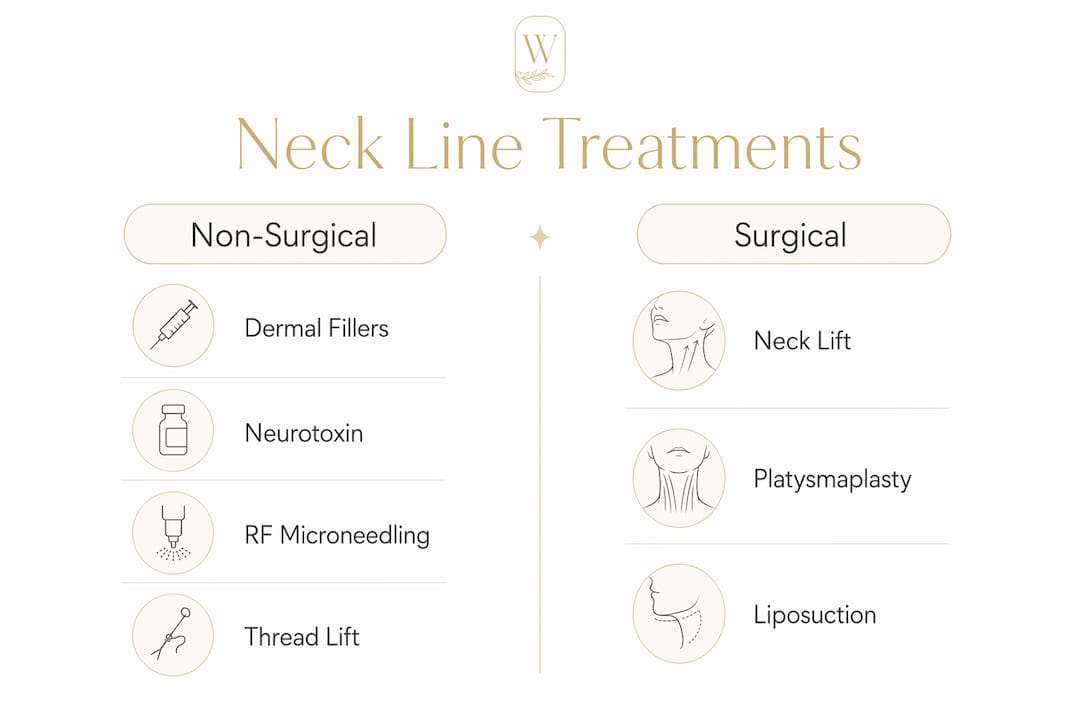
- Non-surgical treatment options available in Singapore
- When is non-surgical care enough, and when should you consider surgery?
- What to expect during and after treatment
- How to prevent tech neck lines at home
- How Houseofwellnesssg assesses and treats neck lines
- Key Takeaways
- What clinicians actually see — and what patients often misunderstand
- Ready to address your neck lines at Houseofwellnesssg?
- Useful sources and further reading
What exactly are tech neck lines?
"Tech neck" is an informal term for the horizontal creases that form on the neck from repeated forward head posture, most commonly from looking down at phones and screens. Clinically, these are classified as horizontal neck wrinkles, and they sit in a different category from the vertical platysmal bands that run lengthwise down the neck.
Understanding which type you are dealing with matters because each responds to different treatments.
Three practical categories:
- Fine or crepey lines. Shallow, surface-level texture changes caused by dehydration, UV damage, and thinning skin. They look like crinkled tissue paper and feel dry to the touch.
- Dynamic folds. Deeper creases that appear or deepen when you look down or tilt your head. These are driven partly by platysma muscle movement and partly by the skin folding repeatedly in the same place.
- Deep static horizontal creases. Persistent lines visible even when the neck is in a neutral position. These reflect significant collagen and volume loss in the dermis and are the most challenging to address without injectables or energy devices.
Associated signs worth noting before a consultation: skin laxity when you pinch the neck skin gently, visible vertical platysmal bands at rest, uneven pigmentation, and a crepey texture that persists even when the neck is extended. Each of these signals a different treatment priority.
Why do tech neck lines form?
The mechanism is layered, which is exactly why single-step fixes often disappoint. Four interacting drivers create and deepen neck lines over time.
- Repeated mechanical folding. Every time you look down at a screen, the skin at the front of your neck creases in the same place. Over years, those creases become permanent. Mayo Clinic Health System confirms that sustained forward head posture increases cervical load and causes muscle strain, compounding the skin-folding effect.
- Platysma muscle activity. The platysma is a broad, flat muscle running from the chest to the jaw. Its overactivity and loss of tension both contribute to horizontal creasing and vertical banding. This is the target for neurotoxin treatments.
- Dermal thinning and collagen loss. Collagen and fibroblast density in the skin dermis naturally decreases with age, reducing volume and elasticity. This is the target for biostimulatory injectables and radiofrequency devices.
- Chronic UV exposure and dehydration. The neck receives daily sun exposure but is frequently skipped in sunscreen application. UV damage accelerates collagen breakdown and worsens pigmentation.
Each cause maps to a specific treatment target. Muscle movement points toward neurotoxin. Dermal thinning calls for biostimulants or radiofrequency. Crepey surface texture responds to skinboosters or resurfacing. That mapping is the foundation of a good multimodal plan.
Pro Tip: Neck skin has fewer sebaceous glands than facial skin, making it drier and more prone to irritation. Experienced practitioners adopt gentler, staged protocols for the neck rather than applying the same device settings used on the face.
Non-surgical treatment options available in Singapore
The options below represent the current standard of non-surgical neck rejuvenation. Each has a different mechanism, a different best-fit line type, and a different recovery profile. Costs are approximate Singapore market ranges and will vary by clinic and the number of units or sessions required.

Hyaluronic acid dermal fillers
Hyaluronic acid (HA) is an endogenous polysaccharide that binds water and restores dermal volume. Injected into horizontal neck creases, it plumps the line from below and stimulates collagen synthesis. A published case study in PMC found that combining HA injections with thread-lifting produced satisfactory outcomes in all ten patients at six-month follow-up, with only mild, short-lived bruising and redness reported. The neck's thin skin requires lower-viscosity, non-cross-linked HA to minimize the risk of lumps or the Tyndall effect.
Botulinum toxin (neurotoxin)
Botulinum toxin relaxes the platysma muscle, softening dynamic folds and reducing the downward pull on lower-face structures. Because the platysma is larger and stronger than most facial muscles, neck neurotoxin treatments require more units than typical facial injections, which is reflected in higher unit counts and costs. Careful placement by a trained practitioner is non-negotiable to avoid functional weakness.
Radiofrequency microneedling (RF microneedling)
RF microneedling delivers controlled radiofrequency energy through fine needles into the dermis, triggering collagen and elastin remodeling. It addresses both surface texture and deeper structural laxity. The radiofrequency treatments at Houseofwellnesssg use this principle to lift and tighten skin with minimal downtime.
Skinboosters and hydration injectables
Skinboosters such as Profhilo and Rejuran (PN skin boosters) deliver hydrating and regenerative actives directly into the dermis. Profhilo uses a high-concentration, non-cross-linked HA that spreads through the tissue to improve skin quality and elasticity. Rejuran uses polynucleotides (PN) derived from salmon DNA to stimulate fibroblast activity. Both are available at Singapore clinics and are well-suited for fine, crepey texture and early collagen loss.
Biostimulatory injectables: Sculptra and Radiesse
Sculptra (poly-L-lactic acid, PLLA) and Radiesse (calcium hydroxylapatite, CaHA) work differently from HA fillers. They do not plump immediately. Instead, they stimulate the body's own collagen production gradually over several months, addressing structural dermal deficits. They are better suited for moderate-to-deep lines with significant volume loss, and results develop over a 3–6 month window.
HIFU (high-intensity focused ultrasound)
HIFU delivers focused ultrasound energy to the superficial musculoaponeurotic system (SMAS) layer, triggering a tightening response. It is a noninvasive option for mild-to-moderate laxity, though results vary and energy settings for neck skin require specialist tuning to avoid discomfort or uneven results. Most people see gradual improvement over 2–3 months after a single session.
PDO/thread lift
Polydioxanone (PDO) threads are inserted under the skin to physically lift tissue and stimulate collagen along the thread tract. Smooth threads fill depressions and improve texture; barbed threads provide a more mechanical lift. The PMC case study above used PDO smooth threads alongside HA with good outcomes. Downtime is typically 3–7 days of mild swelling and bruising.
Combination therapy
Multimodal protocols pairing collagen-stimulating injectables or RF microneedling with topical skin preparation and neuromodulators produce more durable neck-line improvement than any single modality. A common Singapore clinic sequence: skinbooster first to improve skin quality, followed by RF microneedling for collagen remodeling, then neurotoxin for dynamic lines, with HA filler for any residual deep creases.
Treatment comparison
| Treatment | Best for | Mechanism | Typical sessions | Downtime | Longevity | Est. cost (SGD) | Common side effects |
|---|---|---|---|---|---|---|---|
| HA dermal fillers | Deep static creases | Plumping + hydration | 1–4 | Minimal (1–3 days) | 6 months | $600 per session | Bruising, Tyndall effect, lumps |
| Botulinum toxin | Dynamic folds, platysmal bands | Muscle relaxation | 1 (repeat every 3–6 months) | None | 3–6 months | $400 | Bruising, functional weakness if misplaced |
| RF microneedling | Crepey texture, mild-moderate laxity | Collagen/elastin remodeling | 3–4 | 2–5 days redness | — | $500 per session | Redness, swelling, pinpoint marks |
| Skinboosters (Profhilo/Rejuran) | Fine/crepey lines, skin quality | Hydration + fibroblast stimulation | 2–3 | Minimal | 6 months | $500 per session | Mild swelling, bruising |
| Sculptra (PLLA) | Moderate-deep lines, volume loss | Gradual collagen stimulation | 2–3 | Minimal | 18–24 months | $1,000 per vial | Nodules (rare), swelling |
| Radiesse (CaHA) | Moderate-deep lines, laxity | Collagen stimulation + immediate volume | 1–2 | 1–3 days | — | $800 per session | Bruising, swelling |
| HIFU | Mild-moderate laxity | Ultrasound SMAS tightening | 1 (annual) | None to minimal | — | $800 | Discomfort, temporary redness |
| PDO/thread lift | Moderate laxity, texture | Mechanical lift + collagen induction | 1 | 3–7 days | — | $800 | Bruising, swelling, thread visibility |
Cost ranges are approximate Singapore market estimates. Actual pricing depends on the number of units, vials, or sessions required and varies by clinic.
When is non-surgical care enough, and when should you consider surgery?
For most people reading this, a well-designed non-surgical program is the right starting point. Here is how to think about the decision.
Non-surgical is usually sufficient when:
- Lines are primarily surface texture, fine, or crepey
- Laxity is mild to moderate and skin still has reasonable elasticity
- Dynamic folds are the main concern rather than structural sagging
- You are in your 30s to early 50s with good baseline skin quality
- Your goal is meaningful improvement, not a dramatic structural change
Consider a surgical referral when:
- Skin laxity is severe, with significant excess skin that hangs or folds
- Vertical platysmal bands are heavy and visible at rest, contributing to jowling
- Previous non-surgical treatments have plateaued and results are no longer satisfying
- A long-term structural lift is the primary goal
A surgical consult with a board-certified plastic surgeon is the appropriate next step in those cases. That is a referral decision, not a reason to skip non-surgical options entirely. Many patients benefit from a non-surgical program first and consider surgery only if they want further improvement years later.
What to expect during and after treatment
Typical treatment pathway
A well-run clinic follows a staged sequence rather than doing everything at once.
- Consultation and baseline photos. Skin type, laxity, line depth, and platysmal activity are assessed. Photos are taken for comparison.
- Skin preparation. A 4–6 week home-care phase (SPF, antioxidants, gentle hydration) primes the skin before energy devices or injectables.
- Primary modality session. RF microneedling, HIFU, or a booster injection, depending on the assessment.
- Follow-up and combination sessions. Spaced 4–6 weeks apart, adding complementary modalities as the skin responds.
- Maintenance. Most treatments require top-up sessions every 6–18 months to sustain results.
Timeline and recovery
| Procedure | Immediate | Visible change | Maintenance interval |
|---|---|---|---|
| HA fillers | Mild bruising/swelling | Immediate, improves over 2 weeks | Every 6 months |
| Botulinum toxin | Minimal | 5–7 days | Every 3–6 months |
| RF microneedling | Redness, pinpoint marks | 4–6 weeks | Every — |
| Skinboosters | Mild swelling | 4–6 weeks | Every 6 months |
| Sculptra/Radiesse | Minimal | — | Every 6–24 months |
| HIFU | None to mild redness | — | Annually |
| PDO threads | Bruising, swelling | 4–6 weeks | Every — |
Aftercare checklist
- Apply broad-spectrum SPF 30+ every morning, including the neck and décolletage
- Keep the neck moisturized; avoid active exfoliants for 5–7 days post-procedure
- No intense heat (saunas, hot yoga) for 48–72 hours after energy-device sessions
- Avoid heavy exercise for 24 hours after injectables
- Contact the clinic if you notice unusual swelling, nodules, or asymmetry beyond the first week
- Schedule your follow-up or top-up session before leaving the clinic
How to prevent tech neck lines at home
Prevention is not a consolation prize. For anyone in their 20s or early 30s, consistent daily habits can delay the need for clinic intervention by years.
Ergonomics
- Raise your phone or laptop screen to eye level so your head stays in a neutral position
- Change position every 20 minutes — a short walk, shoulder rolls, or a gentle neck rotation resets muscle tension and restores blood flow
- Use a laptop stand and external keyboard at your desk; prop your phone on a stand during long calls
Neck skincare routine
Extending your face routine down to the neck is one of the simplest and most underused neck wrinkle solutions. The Cleveland Clinic recommends applying a topical antioxidant (vitamin C, vitamin E, or ferulic acid) to the neck and chest every morning after cleansing, followed by SPF 30 or higher. In the evening, hyaluronic acid applied morning and night helps restore skin barrier function and reduce surface lines. Retinoids are effective for collagen stimulation but require caution on neck skin. Start at 1–2 times per week with a lower-strength formula, as the neck has fewer oil glands and is more prone to dryness and irritation.

Simple exercises to reduce neck lines
Exercises targeting the deep cervical flexors help correct the postural drivers behind tech neck:
- Chin tuck. Gently draw your chin straight back (not down) to activate the deep neck flexors. Hold 5 seconds, repeat 10 times.
- Upper thoracic mobility. Sit tall, clasp hands behind your head, and gently open your chest toward the ceiling. This counters the rounded-shoulder posture that worsens forward head position.
- Doorway stretch. Place forearms on a door frame and step through gently to open the chest and relieve anterior neck tension.
Pro Tip: At-home devices like EMS thermal neck contour tools (such as the Somna Lift) can complement clinic treatments when used consistently, but they work best as adjuncts to professional care, not as replacements for it.
How Houseofwellnesssg assesses and treats neck lines
Houseofwellnesssg takes a whole-body, skin-as-a-system approach to neck rejuvenation. The process begins with an in-clinic assessment that looks at skin texture, laxity, muscle tone, and posture before any treatment is recommended.
What the assessment covers:
- Visual and tactile evaluation of line depth, skin elasticity, and platysmal activity
- Baseline photo documentation for tracking progress
- Skin sensitivity screening, particularly for neck skin's lower tolerance to aggressive protocols
- A staged multimodal plan built around your specific combination of line types and skin condition
Treatment options available at the clinic:
- Radiofrequency heat for collagen stimulation and skin tightening
- Microcurrent sculpting for noninvasive neuromuscular lift
- Cryotherapy for dual lifting and hydration benefits
- Microneedling for collagen induction and skin texture improvement
- Red light therapy as a circulation-boosting and collagen-supporting adjunct
- Targeted skincare using Sothys and Dermalogica products, selected for neck skin sensitivity
The clinic's approach emphasizes customization. Your first session focuses on skin preparation and a primary modality matched to your assessment. Follow-up sessions layer in complementary treatments as your skin responds. Maintenance programs are built into the plan from the start, so results are sustained rather than one-off.
Key Takeaways
A staged, multimodal non-surgical plan matched to your specific line type is the most effective way to reduce horizontal neck lines and prevent further progression.
| Point | Details |
|---|---|
| Identify your line type first | Fine/crepey, dynamic, and deep static lines each respond to different treatments — mismatching wastes time and money. |
| Combination care outperforms single treatments | Pairing RF microneedling, skinboosters, and neurotoxin produces more durable results than any one modality alone. |
| Prevention starts today | Raising screens to eye level, daily SPF on the neck, and chin tuck exercises slow progression before clinic care is needed. |
| Realistic timelines matter | Most energy-device and biostimulatory results develop over several weeks; plan for staged sessions and maintenance every 6–24 months. |
| Houseofwellnesssg offers a customized multimodal program | In-clinic assessment, radiofrequency, microcurrent, cryotherapy, and Sothys/Dermalogica skincare are combined into a personalized neck rejuvenation plan. |
What clinicians actually see — and what patients often misunderstand
The most common misconception we encounter is that one treatment session will erase years of neck lines. It will not, and promising otherwise does a disservice to the people who come in hoping for a quick result.
What actually works is patience and sequencing. Neck skin is structurally different from facial skin. It is thinner, drier, and less forgiving of aggressive energy settings. Practitioners who understand this start conservatively, assess the skin's response, and build intensity gradually. That staged approach is not timidity. It is how you get lasting improvement without scarring or uneven texture.
We are also seeing a clear shift in the age of people asking about neck lines. Younger adults in their late 20s and early 30s are coming in earlier, often motivated by noticing lines in video calls or photos. That is actually a good thing. Early intervention with skinboosters, RF sessions, and a consistent home-care routine produces far better long-term outcomes than waiting until lines are deep and structural.
The other thing worth saying plainly: combination treatments are not just a way to sell more sessions. They address different layers of the same problem. A neurotoxin relaxes the muscle driving the fold. RF microneedling rebuilds the collagen that has thinned. A skinbooster restores the surface hydration that makes everything look smoother. Each one does something the others cannot.
Ready to address your neck lines at Houseofwellnesssg?
Clinic treatments for neck lines work best when they start with a proper assessment, not a menu selection. At Houseofwellnesssg in Tanjong Pagar, Singapore, your first visit includes a skin and posture evaluation, baseline photos, and a personalized treatment plan with transparent SGD pricing before anything begins.

Recommended starter services for neck-line care include radiofrequency skin tightening, microcurrent sculpting, cryotherapy, and red light therapy, all available as standalone sessions or as part of a customized package. Bring your current skincare list and any photos showing your neck concern at its most visible. The clinic uses Sothys and Dermalogica products throughout, selected for their compatibility with sensitive neck skin.
Book your consultation at Houseofwellnesssg to get a clear, honest plan for your specific neck lines — no pressure, no guesswork, just a calm and thorough assessment of what will actually help.
Useful sources and further reading
The following sources informed the clinical claims in this article and are recommended for further reading:
- Fix tech neck: surgical and nonsurgical treatment options — American Society of Plastic Surgeons — treatment options overview and multimodal rationale (Sections 1, 3, 4)
- What Is Tech Neck — and How Can You Prevent It? — Yale Medicine — posture, ergonomics, and prevention (Sections 1, 7)
- Tech neck: Effect of technology — Mayo Clinic Health System — cervical load mechanics and ergonomic correction (Sections 3, 7)
- How to avoid 'tech neck' — Futurity — posture exercises including chin tuck and thoracic mobility (Sections 7, 6)
- How to tighten an aging neck without surgery — Women's Health — neurotoxin dosing, neck skin sensitivity, staged protocols (Sections 3, 4)
- Neck Lines and Wrinkles: Causes and Treatments — Cleveland Clinic — topical skincare ingredients, retinoid caution, SPF guidance (Sections 7, 6)
- A Case Study: Comprehensive Approach for Treating Horizontal Neck Wrinkles Using Hyaluronic Acid Injections and Thread-Lifting — PMC/NCBI — clinical outcomes for HA + thread-lift combination (Section 4)
- HIFU Facial — Skin To Love Clinic — HIFU effectiveness and specialist-tuning considerations (Section 4)
- Houseofwellnesssg services — houseofwellnesssg.com/services — clinic service overview for Singapore readers