

Topical vitamin C brightens skin tone, defends against sun-driven free radical damage, and supports the collagen that keeps your face looking firm. The evidence is strongest at concentrations of 10% to 20% L-ascorbic acid, paired with a daily sunscreen rather than in place of one. For stubborn dark spots or uneven texture, a professional facial can accelerate what a home serum does more gradually.
- Brightens tone and fades dark spots over time
- Adds antioxidant backup to your daily SPF
- Supports collagen production for firmer-looking skin
- Works best when the formula is fresh, stable, and stored properly
- Expect visible change in roughly two to three months, not overnight
Key Takeaways
Topical vitamin C brightens skin, defends against UV-driven free radical damage, and supports collagen production, with visible results typically appearing in 8 to 12 weeks of consistent use.
| Point | Details |
|---|---|
| Choose a stable formula | Look for 10% to 20% L-ascorbic acid or a gentler derivative, paired with vitamin E and ferulic acid. |
| Pair with SPF daily | Vitamin C is an antioxidant backup to sunscreen, not a replacement for it. |
| Apply in the morning | Cleanse, apply vitamin C, moisturize, then finish with sunscreen for the best antioxidant defense. |
| Set realistic expectations | Brightening and texture changes usually appear between 8 and 12 weeks; collagen firming takes longer. |
| Consider a professional boost | Houseofwellnesssg pairs vitamin C application with microcurrent and radiofrequency for faster, more even results. |
Table of Contents
- Vitamin C Facial Benefits Backed by Skin Science
- How Topical Vitamin C Works on Your Skin
- Choosing a Formulation That Actually Stays Stable
- Building Vitamin C Into Your Daily Skincare Routine
- How Long Until You See Results?
- Is Vitamin C Safe for Your Skin Type?
- House of Wellness on Vitamin C in Professional Treatments
- Frequently Asked Questions
- Sources
Vitamin C Facial Benefits Backed by Skin Science
The benefits of a consistent vitamin C routine come down to four mechanisms, and each one shows up differently on your skin.
- Brightening. Vitamin C interferes with tyrosinase, the enzyme your skin uses to produce melanin. Less enzyme activity means less pigment buildup, which is why regular use tends to fade the look of dark spots and even out blotchy tone over weeks.
- Collagen support. Vitamin C acts as a cofactor for the enzymes that cross-link collagen fibers, and it supports the genetic signals that tell skin cells to keep producing collagen. That translates to a gradual firming effect, not an instant one.
- Photoprotection. UV exposure generates free radicals that vitamin C neutralizes before they trigger the enzymes (MMPs) that break down collagen. A 2017 dermatology review describes this antioxidant, photoprotective, and antipigmentary profile as vitamin C's core value in skin care, while flagging formulation stability as the real bottleneck to consistent results.
- Calming irritation. Some trials on twice-daily topical vitamin C reported fewer acne lesions, likely tied to its anti-inflammatory action and effect on sebum. The evidence here is thinner than for brightening, but it's a reasonable secondary benefit if breakouts and redness are part of your concern.
Put together, this is why dermatology-facing sources treat vitamin C as a near-permanent fixture on the "worth it" list rather than a seasonal trend. Cleveland Clinic's guidance notes documented improvement in hyperpigmentation and photoaged skin across multiple clinical studies, though results vary by formulation and skin type. If you're chasing smoother texture, faded spots, and a bit more bounce in your skin, this is the ingredient category doing that work.
How Topical Vitamin C Works on Your Skin
Vitamin C's job inside your skin comes down to chemistry, not magic. As an antioxidant, it donates electrons to neutralize unstable free radical molecules before they damage collagen and DNA in skin cells.
- It acts as a cofactor for the enzymes that stabilize and cross-link collagen, which is part of why long-term use is linked to firmer-looking skin.
- It inhibits tyrosinase, slowing the pigment-production pathway responsible for dark spots and uneven tone.
- It doesn't block UV rays like a sunscreen filter does. Instead, it mops up the free radicals UV exposure creates, which is why it works as a partner to SPF rather than a substitute for it.
- Harvard Health points out that applying vitamin C directly to skin achieves much higher local concentrations than eating vitamin C ever could, because oral intake is filtered through your bloodstream before any reaches your skin.
That last point matters more than most shoppers realize. Taking vitamin C supplements supports overall health, but it won't replicate what a topical serum does at the skin's surface.
Choosing a Formulation That Actually Stays Stable
Not every vitamin C product on the shelf delivers what the label promises, and stability is where most products succeed or fail.
- L-ascorbic acid is the most studied and most potent form, but it's also the least stable and breaks down fastest when exposed to light, air, and heat.
- Derivatives like ascorbyl palmitate or sodium ascorbyl phosphate are gentler and more stable, though generally considered less potent.
- A concentration between 10% and 20% L-ascorbic acid is the commonly recommended range. Higher isn't automatically better. Beyond 20%, irritation risk climbs without much added benefit.
- Pairing vitamin C with vitamin E and ferulic acid measurably improves stability and boosts photoprotective effect compared with vitamin C alone, according to the same dermatology review.
- Look for opaque, airless packaging. Clear bottles and jars exposed to air degrade the formula faster.
- A fresh vitamin C serum is usually pale yellow. If yours has turned dark amber or brown, it has oxidized and lost most of its effectiveness.
Pro Tip: Store your vitamin C serum in a cool, dark drawer, not on a bright bathroom shelf. Singapore's humidity and heat accelerate oxidation faster than most product labels account for.
Building Vitamin C Into Your Daily Skincare Routine
Where vitamin C sits in your routine affects how well it performs, and timing matters as much as the product itself.
- Cleanse first. Start with a clean, dry face so the serum can absorb without competing with residue.
- Apply vitamin C in the morning. This is when its antioxidant defense against daytime UV and pollution exposure earns its keep.
- Follow with moisturizer, then always finish with sunscreen. Vitamin C strengthens your sun defense; it doesn't replace it.
- Start every other day if you have sensitive skin, then build up to daily use as your skin adjusts.
- Be careful layering with retinoids or exfoliating acids. Using vitamin C in the morning and retinoids at night avoids most conflicts. If you want to use both at once, apply the more acidic product first and wait a few minutes before layering.
- Use a nickel-sized amount across your face, neck, and décolletage. Skipping the neck is a common mistake, since sun damage doesn't stop at your jawline.
Pro Tip: If your skin tingles slightly the first few times, that's normal. Persistent burning or visible redness that doesn't fade within an hour means you should dial back frequency or switch to a gentler derivative.
How Long Until You See Results?
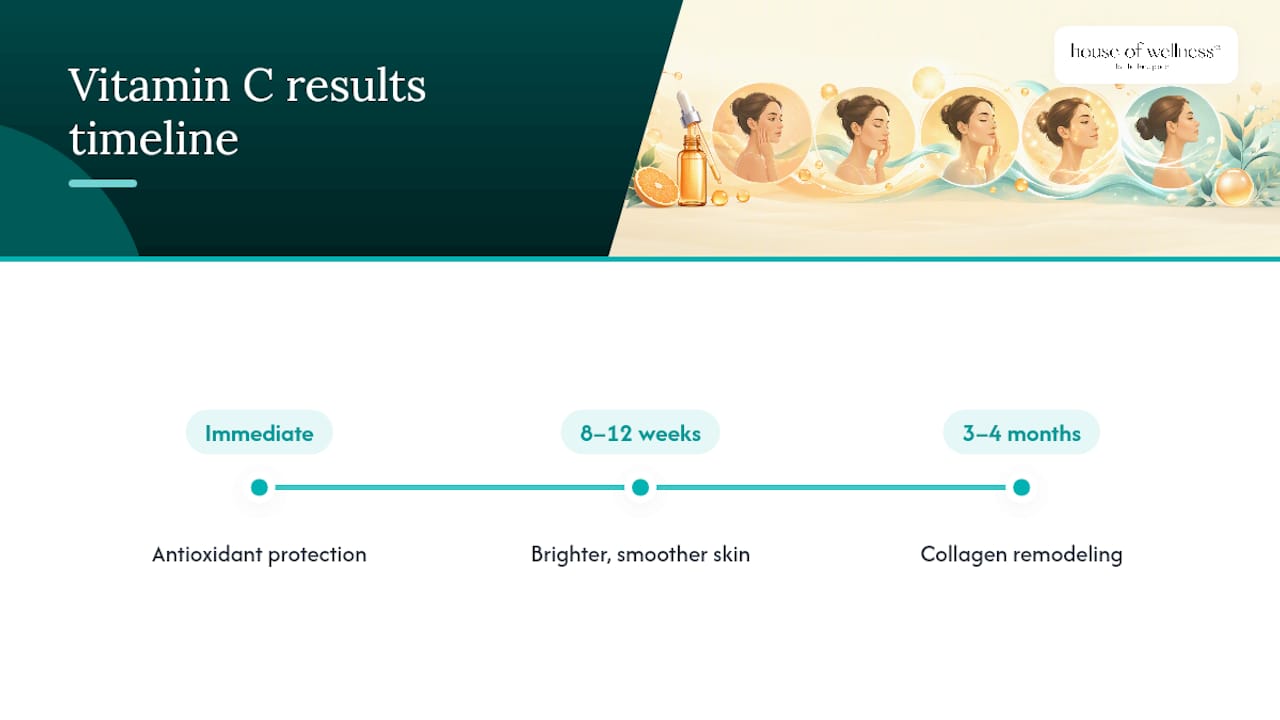
Antioxidant protection starts working the moment you apply vitamin C, but visible changes take longer to surface. Most people notice brighter, more even tone and smoother texture somewhere between eight and twelve weeks of consistent use, which lines up with the skin's natural cell turnover cycle. Collagen remodeling runs on a slower clock, often showing meaningful firmness changes closer to the three or four month mark.
Clinical reviews covering topical vitamin C consistently flag one caveat: results vary by formulation, skin type, and study size, and most trials involve relatively small groups of participants. That's not a reason to skip vitamin C. It's a reason to commit to one stable, well-formulated product for at least two to three months before judging whether it's working for your skin.

Is Vitamin C Safe for Your Skin Type?
Most people tolerate topical vitamin C well, but a small percentage experience mild tingling or transient redness right after application, especially with higher concentrations of L-ascorbic acid. That typically fades within the hour and lessens as your skin builds tolerance.
- Stop use and consult a dermatologist if you notice persistent burning, swelling, or breakouts that don't settle after a week.
- If you have active eczema, severe rosacea, or open wounds, talk to a clinician before adding vitamin C to your routine.
- When shopping in Singapore, buy from reputable local retailers or clinics rather than unverified online resellers, and always check the expiry date and packaging seal before purchase.
- Read the label for the specific form used (L-ascorbic acid versus a derivative), the stated concentration, and whether vitamin E or ferulic acid is included for stability.
House of Wellness on Vitamin C in Professional Treatments
Houseofwellnesssg incorporates vitamin C into facial treatment plans alongside modalities like microcurrent, radiofrequency, and cryotherapy, since stabilized formulas often show faster, more even results when combined with professional delivery methods.
Every skin consultation at Houseofwellnesssg starts with an assessment of your specific pigmentation, texture, and sensitivity, so the vitamin C application and any paired modality is calibrated to your skin rather than applied as a one-size treatment.
Aftercare typically means continuing a home serum and daily SPF between sessions to hold onto results.
Clinic Facial or Home Serum: Which Should You Choose?
If you're dealing with stubborn pigmentation, mixed signs of sun damage, or want faster visible change, a professional facial tends to outperform a serum alone. If your concern is mild or you're maintaining results between visits, a well-formulated home serum usually does the job. Either way, an in-person skin assessment before advanced treatment is worth the time.
Book a Vitamin C–Enhanced Facial in Singapore
Houseofwellnesssg gives you a faster path to visible brightening than a home serum alone, without locking you into a fixed monthly product routine. Sessions combine professional-grade vitamin C application with modalities like ProRestore or microcurrent toning, tuned to your skin during a one-on-one consultation rather than a generic protocol.

Most clients see brighter, smoother skin immediately after a session, with pigmentation and texture improvements building over repeat visits, mirroring the eight to twelve week timeline seen with home serums but often more pronounced. If dark spots, dullness, or early signs of photoaging are your main concern, book a facial at Houseofwellnesssg's Tanjong Pagar studio and get a skin assessment before deciding on a treatment plan.
Frequently Asked Questions
Does vitamin C brighten skin? Yes. It inhibits tyrosinase, the enzyme responsible for melanin production, which fades dark spots and evens out tone with consistent use over several weeks.
What concentration of vitamin C serum works best? Most dermatology-facing sources point to 10% to 20% L-ascorbic acid as the effective range. Going higher raises irritation risk without much added benefit.
Can I use vitamin C serum every day? Yes, once your skin tolerates it. Sensitive skin types should start every other day and build up to daily morning use.
Should vitamin C replace my sunscreen? No. Vitamin C neutralizes free radicals from UV exposure, but it doesn't block UV rays the way sunscreen does. Use both together.
How long before I see results from vitamin C? Antioxidant protection starts immediately, but visible brightening and texture changes typically take 8 to 12 weeks of steady use.
This article is general information, not a substitute for advice from a qualified doctor. Consult a qualified healthcare professional about your own circumstances before acting on anything here.
Sources
- Vitamin C Serum: Benefits, How to Apply (Cleveland Clinic)
- Topical vitamin C in skin care: mechanisms and clinical application (PMC)
- Why is topical vitamin C important for skin health? (Harvard Health Blog)
- A guide to vitamin C serums (Healthline)